

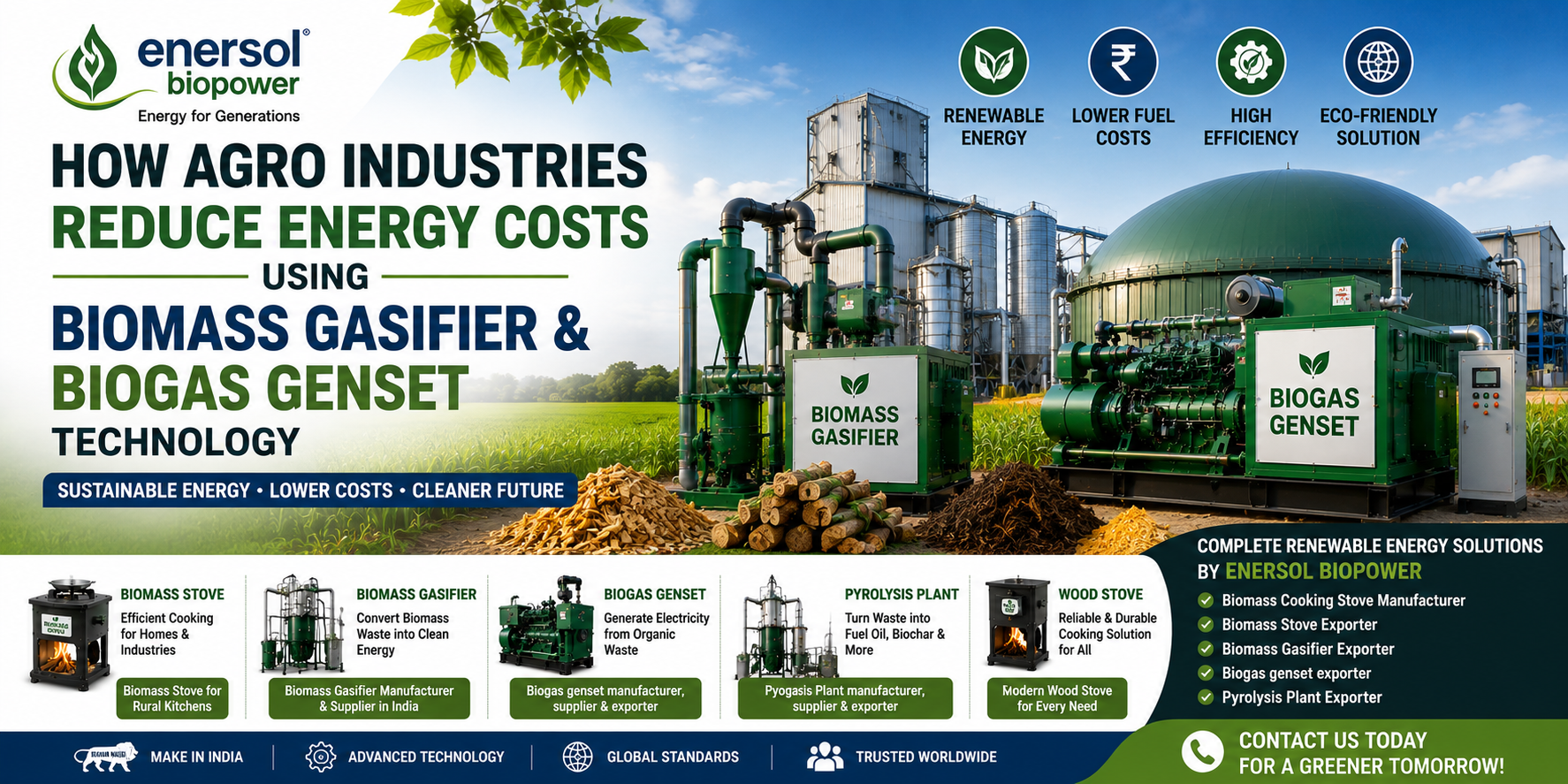
The Hidden Drain: Why Diesel & LPG Are Crippling Agro-Industries
For most agro-industrial operators — rice millers, tea estate managers, spice processors, cold storage owners — fuel is the single largest controllable operational expense. And in recent years, that expense has become brutally unpredictable.
Consider this: a mid-sized rice mill running two 8-hour shifts daily can spend anywhere between ₹1.5 lakh to ₹3.5 lakh per month on diesel and electricity alone, depending on size and location. A tea processing estate requiring continuous heat for withering and drying machinery faces even steeper LPG and furnace oil bills during peak season.
The core problem has three parts:
- Price volatility: Diesel and LPG prices fluctuate with global crude oil markets, making budgeting nearly impossible.
- Supply dependency: Remote agro-processing facilities face delayed fuel deliveries that halt production.
- Missed opportunity: These same facilities generate tonnes of agricultural residue — rice husk, stalks, shells — that is often burned openly or dumped at significant cost.
Biomass gasification doesn't just reduce your fuel bill — it turns a waste disposal problem into your primary energy source, fundamentally changing your cost structure.
How Biomass Gasification Works — And Why It's Different
A biomass gasifier is not an incinerator and it is not a boiler. It is a thermochemical conversion system that transforms solid agricultural waste into a combustible gas — called producer gas or syngas — through a precisely controlled, partial-oxidation process.
Here's the process in plain language:
-
Biomass Feeding
Agricultural residues (rice husk, wood chips, cotton stalks) are fed into the reactor, either continuously via automated feed systems or in batch mode.
-
Controlled Gasification
Inside the reactor at temperatures of 700–1,000°C with limited air supply, biomass undergoes partial oxidation, devolatilization, and reduction — producing a combustible gas mixture rich in CO, H₂, and CH₄.
-
Gas Cleaning & Conditioning
The raw syngas passes through cyclone separators and scrubbers to remove particulates and tar, ensuring clean gas suitable for direct use in burners, kilns, dryers, and engines.
-
Direct Utilization
Clean producer gas replaces diesel in dual-fuel gensets or LPG/furnace oil in thermal applications — delivering the same output at a fraction of the cost.
Your Waste Is Already the Fuel: Common Agro-Residue Feedstocks
One of the most powerful financial arguments for biomass gasification is that your feedstock — the raw material for your energy — is likely already being generated as waste on-site or at minimal procurement cost nearby. Here are the most commonly used agro-residue feedstocks across Indian industries:
Rice Husk
Produced in massive quantities at every rice mill. Typically has 13–14% ash content and ~3,200 kcal/kg. One of the most cost-effective gasifier feedstocks in India.
Best for: Rice mills, parboiling units
Wood Chips & Sawdust
High calorific value (~4,200 kcal/kg) and low ash content make wood chips ideal for high-temperature applications requiring consistent heat output.
Best for: Tea estates, timber processors, food dryers
Groundnut Shells & Cotton Stalks
Widely available in agricultural belts of Gujarat, Maharashtra, and Andhra Pradesh. Low procurement cost and decent calorific value (~3,600 kcal/kg).
Best for: Oil expellers, cotton gins, spice processors
Sugarcane Bagasse & Cobs
After moisture reduction, bagasse becomes an excellent gasifier feedstock with ~2,800 kcal/kg. Widely available in Maharashtra, UP, and Karnataka sugar belts.
Best for: Sugar mills, ethanol plants, distilleries
Pro Tip: Feedstock procurement cost in most agro-belts ranges from ₹1.50 to ₹4.00 per kg, compared to diesel at ₹85–95/litre. Since 1 kg of biomass replaces approximately 0.3–0.4 litres of diesel equivalent, the economics are extremely favorable even before any other savings are counted.
Dual-Fuel vs. 100% Gas Mode: Choosing What's Right for Your Industry
Enersol Biopower's gasifiers are engineered to offer operational flexibility depending on your current infrastructure, risk appetite, and the nature of your energy load:
| Parameter | Dual-Fuel Mode | 100% Producer Gas Mode |
|---|---|---|
| Application | Power generation (diesel genset) | Thermal processes (kilns, dryers, boilers) |
| Diesel / LPG Replaced | 70–80% | Up to 100% |
| Transition Complexity | Low — retrofit to existing genset | Medium — new burner/process adaptation |
| Backup Availability | Diesel available as immediate fallback | Requires stable feedstock supply chain |
| Cost Savings | 45–55% on fuel costs | 55–65% on fuel costs |
| Best For | Rice mills, cold storage, agro-processing | Tea estates, brick kilns, spice dryers |
Most first-time adopters begin with dual-fuel mode to minimize disruption to existing operations, then migrate to 100% gas mode as feedstock logistics are established and operators become familiar with the system. Enersol Biopower's technical team guides this transition as part of the installation and commissioning process.
Case Studies: Real ROI from Rice Mills, Tea Estates & Cold Storage
The following case study profiles are representative of the outcomes achieved by Enersol Biopower clients in similar industries and operating conditions. Exact figures will vary based on plant size, feedstock cost, and operational hours.
Large-Scale Rice Mill — Punjab, India
The Challenge: This rice mill was spending nearly ₹2.8 lakh monthly on diesel for its power generation needs across milling and parboiling operations. With 50+ tonnes of rice husk generated daily and no productive use for it beyond open burning, the management was looking for a dual solution.
The Solution: A dual-fuel biomass gasifier system was installed, converting rice husk (procured at near-zero cost from on-site production) into producer gas. The gasifier was integrated with their existing diesel gensets in dual-fuel configuration.
Results After 6 Months: Diesel consumption dropped by 72%. Monthly fuel cost reduced from ₹2.8 lakh to under ₹85,000 — a saving of ~₹1.95 lakh per month. With system cost amortized over 14 months, the mill also eliminated open-burning penalties under local pollution norms.
💡 Net Monthly Savings: ~₹1.95 Lakh | Annual Savings: ~₹23.4 Lakh | ROI Period: ~14 months

About the Author
Rai Singh Dahiya
Founder & Chief Innovator, Enersol Biopower Pvt. Ltd.
Grassroots innovator and recipient of India's Fifth National Grassroots Innovation Award (2009). Selected as Innovation Scholar-in-Residence at Rashtrapati Bhavan (2015). Over 25 years of experience pioneering clean biomass energy solutions deployed at IITs, NITs, and in UNDP international projects across Africa and the Middle East.
Tea Processing Estate — Assam
The Challenge: Tea withering and drying are energy-intensive processes requiring large volumes of consistent, controllable heat. This estate relied on LPG and furnace oil for its withering troughs and rotary dryers, with combined monthly energy costs of ₹3.4 lakh during peak seasons.
The Solution: A 100% producer gas mode biomass gasifier was configured, fed with locally sourced wood chips and pruning waste from the estate's own tea bushes — effectively zero-cost feedstock. The gasifier was connected directly to the estate's withering and drying equipment via a dedicated gas pipeline.
Results: LPG and furnace oil consumption reduced to zero for 10 months of the year. Peak-season supplementary fuel requirements dropped by 90%. Consistent gas output ensured product quality was maintained. Monthly savings averaged ₹2.2 lakh.
💡 Net Monthly Savings: ~₹2.2 Lakh | Annual Savings: ~₹26.4 Lakh | ROI Period: ~16 months
Cold Storage & Food Processing Unit — Maharashtra
The Challenge: Unreliable grid power in rural Maharashtra meant this cold storage unit was running diesel gensets for 12–16 hours daily, in addition to erratic grid bills. Diesel costs alone crossed ₹4.1 lakh in peak summer months.
The Solution: A dual-fuel gasifier was installed alongside their existing DG set. Groundnut shells and cotton stalks — abundantly available within 10 km of the facility at ₹2.50/kg — became the primary fuel. The system was engineered to handle variable loads typical of refrigeration compressors.
Results: Diesel consumption dropped by 75%. With feedstock costing approximately ₹60,000/month to sustain operations, net monthly fuel expenditure dropped from ₹4.1 lakh to ₹1.05 lakh — a saving of ₹3.05 lakh per month. This facility achieved full ROI in just 12 months.
💡 Net Monthly Savings: ~₹3.05 Lakh | Annual Savings: ~₹36.6 Lakh | ROI Period: ~12 months
How to Estimate Your ROI in 5 Minutes
You don't need a consultant to get a rough picture of your savings potential. Use this simple framework to estimate whether biomass gasification makes financial sense for your facility:
Quick ROI Estimation Framework
-
Your current monthly fuel cost (diesel/LPG): Note this figure. Include DG running costs and any LPG or furnace oil used for thermal processes.
-
Estimated fuel savings (55%): Multiply A × 0.55. This is a conservative estimate of monthly savings after gasifier installation and feedstock procurement costs.
-
System investment (indicative): Enersol Biopower systems for agro-industrial scale typically range from ₹18–60 lakh depending on capacity. Request a formal quotation for accurate pricing.
-
Simple ROI period: Divide C by B (monthly savings). This gives the number of months to recover your investment. Most agro-industrial clients land in the 12–18 month range.
Example: If your current monthly diesel bill is ₹2,50,000, your estimated monthly saving is ₹1,37,500. With a ₹22 lakh system investment, your simple ROI period is approximately 16 months — well within the industry benchmark for energy-efficiency capex.
Why Agro-Industries Choose Enersol Biopower
Enersol Biopower's biomass gasifiers are engineered specifically for the operational realities of agro-industrial environments — variable feedstock quality, seasonal demand fluctuations, remote locations, and limited in-house engineering resources. Here's what sets our systems apart:
| Capability | Enersol Advantage | Impact on Your Operations |
|---|---|---|
| Multi-Feedstock Flexibility | Handles rice husk, wood chips, stalks, shells | Uninterrupted operation despite seasonal feedstock changes |
| PLC-Based Automation | Touchscreen control, remote monitoring-ready | Minimal skilled labour requirement; 24/7 uptime |
| Modular Scalability | Start with 100 kg/hr; scale to 1,000+ kg/hr | Grow capacity without replacing your core system |
| Emission Compliance | CPCB & global emission norms compliant | Smooth regulatory approvals; avoids open-burning fines |
| Site & Application Engineering | Custom integration with your existing infrastructure | No need to replace current equipment |
| After-Sales Support | Dedicated commissioning + ongoing AMC options | Protects your investment long-term |
Frequently Asked Questions (FAQs)
How much fuel cost can a biomass gasifier save?
Agro-industries switching from diesel or LPG to biomass gasification typically report fuel cost reductions of 50–65%, depending on feedstock availability, plant capacity, and operational hours. Most Enersol clients in agro-processing report savings in the ₹1–3 lakh/month range.
What agricultural waste can be used as gasifier feedstock?
Common feedstocks include rice husk, sugarcane bagasse, cotton stalks, wood chips, coconut shells, groundnut shells, and other dry agro-residues with low moisture content. Moisture content should ideally be below 20% for optimal performance.
What is the typical ROI timeline for a biomass gasifier?
Most agro-industrial users of Enersol Biopower gasifiers achieve full return on investment within 12 to 18 months, based on current diesel/LPG prices and feedstock availability. Facilities with higher fuel loads and access to low-cost or on-site feedstock typically achieve ROI faster.
Can a biomass gasifier fully replace diesel in my factory?
Yes. Enersol Biopower's gasifiers offer both dual-fuel mode (reducing diesel by 70–80%) and 100% producer gas mode for complete fossil fuel replacement in thermal applications. Your technical team will recommend the optimal mode based on your application and existing equipment.
Is there government support or subsidy for biomass gasifiers in India?
Yes. MNRE (Ministry of New and Renewable Energy) and several state renewable energy development agencies (like RRECL, HAREDA, GEDA) offer capital subsidies and performance-linked incentives for biomass gasification projects. Enersol Biopower can assist with identifying applicable schemes during the project feasibility stage.
Take the First Step Toward Fuel Independence
The agro-industries already winning on fuel costs aren't doing anything exotic — they're using waste that's already on their premises to replace the diesel they're buying every month. Biomass gasification is a proven, industrial-grade technology with a 12–18 month payback, CPCB-compliant emissions, and the backing of an experienced manufacturer who understands agro-industrial operations.
Whether you're running a rice mill in Punjab, a tea estate in Assam, a cold storage in Maharashtra, or a spice processing unit in Kerala — the fundamentals are the same: your biomass waste is a liability waiting to become an asset.
Talk to the Enersol Biopower technical team today. Share your current fuel bill, your biomass type, and your daily processing capacity — and get a customized feasibility estimate with projected savings and payback period. Visit enersolbiopower.com to get started.
Ready to Cut Your Fuel Bill by 60%?
Share your industry type, current fuel costs, daily biomass availability, and processing capacity. The Enersol Biopower team will prepare a customized ROI assessment — at no charge.