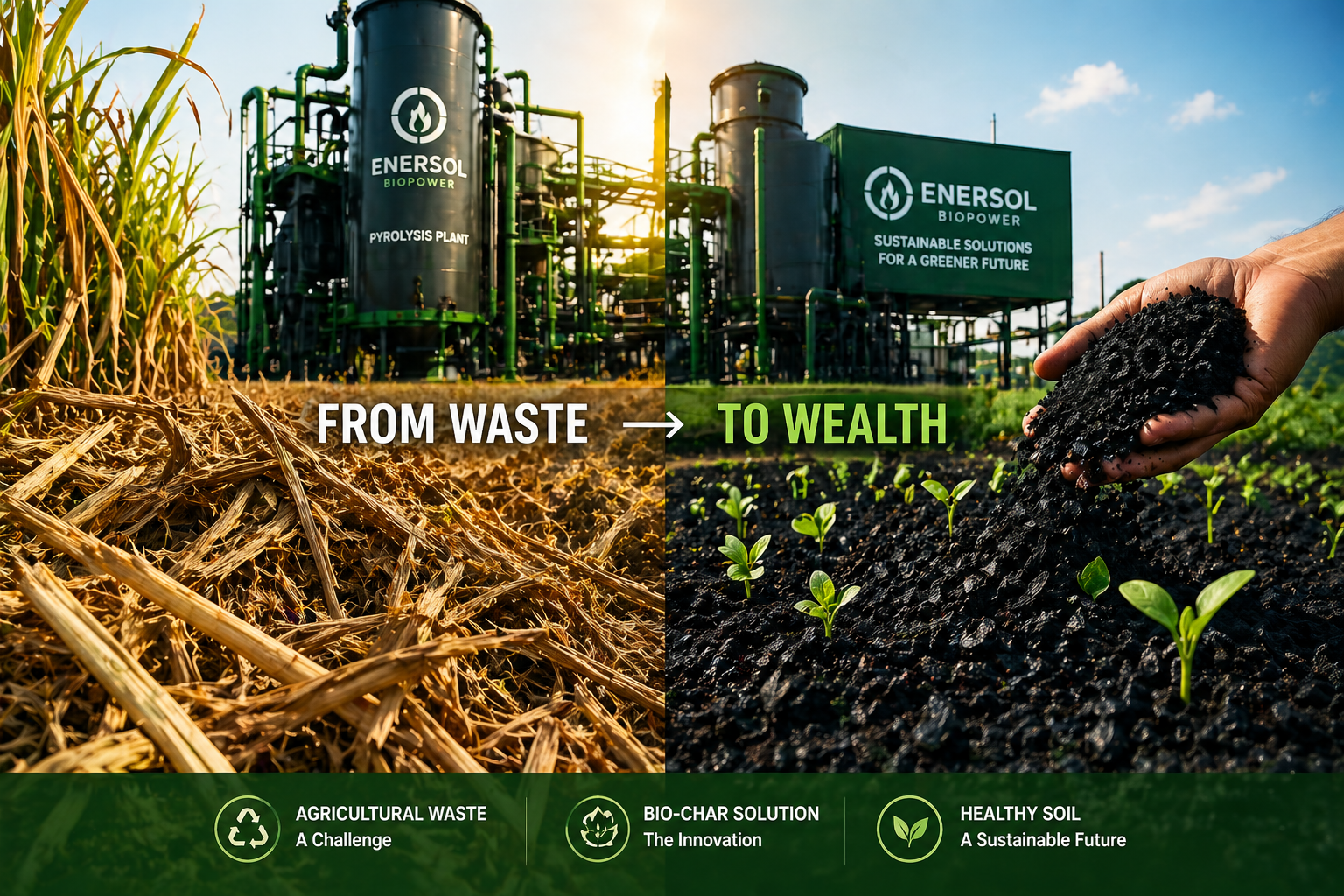
The Stubble Burning Crisis: India's Invisible Environmental Emergency
Every October and November, satellite images of northern India glow with thousands of fire points as farmers in Punjab, Haryana, and Uttar Pradesh burn their rice paddy stubble to clear fields quickly before the winter wheat sowing season. The practice, known as parali burning, is not born of ignorance — it is born of economic compulsion. Manual crop residue removal costs ₹5,000–₹8,000 per acre; burning is essentially free.
The consequences, however, are catastrophic and far-reaching:
The True Cost of Stubble Burning:
- Air Quality Catastrophe: Delhi's AQI routinely spikes to 400–500+ during burning season — classified as "Severe" and hazardous to all human populations.
- Soil Microbiome Destruction: Open burning kills beneficial soil microorganisms in the top 2–5 cm layer, degrading soil structure and long-term fertility.
- Carbon Emissions: Burning 1 tonne of crop residue releases approximately 1.5 tonnes of CO₂ equivalent, plus methane, nitrous oxide, and black carbon.
- Economic Loss: The crop residue being burned contains significant nitrogen, phosphorus, and potassium — nutrients that farmers then pay to replace with chemical fertilizers.
- Legal Exposure: Under NGT (National Green Tribunal) orders, farmers face fines of ₹2,500–₹15,000 per fire incident — yet enforcement remains difficult at scale.
The problem demands a solution that is not merely legal compliance — but economically superior to burning. Biomass pyrolysis and Bio-Char production is precisely that solution: one that pays farmers and processors to process the stubble rather than burn it.
What Is Bio-Char? The Carbon Material Changing Agriculture
Bio-Char is a highly porous, carbon-rich solid material produced when organic biomass — crop residue, wood chips, coconut shells, or municipal organic waste — is heated to temperatures of 300–700°C in a low-oxygen or oxygen-free environment. This process, called pyrolysis, is fundamentally different from combustion: instead of burning the carbon away as CO₂, it stabilizes it in a solid form that persists in soil for hundreds to thousands of years.
Think of Bio-Char as the agricultural world's equivalent of activated charcoal — but instead of filtering water, its porous structure filters and holds the very nutrients and moisture that plant roots need to thrive.
Bio-Char vs. Ash: A Critical Distinction
| Property | Bio-Char (Pyrolysis) | Ash (Open Burning) |
|---|---|---|
| Carbon Retention | 70–80% of original carbon locked in | 90%+ released as CO₂ |
| Soil Longevity | Stable for 100–10,000+ years | Leaches away within 1–2 seasons |
| Porosity & Surface Area | Highly porous — up to 300 m²/g | Minimal, structurally collapsed |
| By-Products | Syngas + Bio-oil (energy value) | Toxic smoke, particulates, GHGs |
| Economic Value | ₹8,000–₹25,000 per tonne (market) | Zero — and incurs penalties |
The ancient civilizations of the Amazon understood this intuitively — regions of Terra Preta (dark earth) enriched with charcoal millennia ago remain astonishingly fertile to this day. Modern science has simply given us the industrial tools to replicate this phenomenon at scale, with precision.
The Pyrolysis Process: How Waste Becomes Wealth
Enersol Biopower's biomass torrefaction and pyrolysis plants are engineered to process agricultural residue through a controlled thermochemical conversion pathway — producing three commercially valuable outputs simultaneously. Here's how the process works:
Biomass Input
Crop residue, wood chips, shells
Pyrolysis Reactor
300–700°C, oxygen-limited
Three Outputs
Bio-Char + Syngas + Bio-oil
Bio-Char
20–35% of input biomass by weight. Stable carbon material for soil application. Market value: ₹8,000–₹25,000/tonne.
Syngas
Non-condensable gases (CO, H₂, CH₄). Used as process fuel to sustain the pyrolysis reactor and power auxiliary operations — reducing external energy input.
Bio-Oil / Pyroligneous Acid
Liquid condensate with applications as a natural pesticide, wood preservative, or further refined as fuel. Adds a third revenue stream to the operation.
Step-by-Step: Inside an Enersol Biopower Pyrolysis Plant
-
Feedstock Preparation & Drying
Agricultural residues are collected, sized to optimal particle dimensions (typically <50mm), and pre-dried to a moisture content below 20%. Consistent feedstock quality at this stage is critical for stable reactor performance and Bio-Char quality.
-
Continuous Feed into Pyrolysis Reactor
Prepared biomass is continuously fed into the reactor chamber via an auger-screw or rotary-drum system. The reactor maintains precise temperatures (300–700°C depending on desired output characteristics) with strictly controlled oxygen levels — far below combustion threshold.
-
Thermochemical Decomposition
At pyrolysis temperatures, biomass undergoes devolatilization — complex organic molecules break down into three fractions: solid Bio-Char (carbon-rich residue), volatile gases (syngas), and condensable vapours (bio-oil precursors). The proportions of each depend on reactor temperature, residence time, and heating rate.
-
Gas Condensation & Separation
Volatile gases exiting the reactor pass through a condensation train. Condensable fractions (bio-oil and pyroligneous acid) are separated and collected. Non-condensable syngas is recirculated as process fuel — making the pyrolysis operation largely energy self-sufficient after startup.
-
Bio-Char Cooling & Discharge
Solid Bio-Char is discharged from the reactor base via a water-cooled screw conveyor, rapidly reducing temperature to prevent re-ignition. The cooled Bio-Char is then screened, characterized for quality parameters (pH, ash content, carbon content), and prepared for bagging or bulk dispatch.
Enersol's Technical Edge: Our pyrolysis plants feature PLC-based temperature control, real-time gas composition monitoring, and modular design that allows capacity scaling from 200 kg/hr to 2,000+ kg/hr of biomass input — matching the processing capacity of individual farms, farmer producer organizations (FPOs), or large-scale agro-industrial operators.
Bio-Char's Remarkable Benefits for Soil Health
What makes Bio-Char so extraordinary as a soil amendment is that its benefits are not fleeting. Unlike compost, which decomposes within years, Bio-Char's highly stable carbon structure means its soil-improving properties persist for decades to centuries. Here's what scientific research and field applications consistently demonstrate:
Moisture Retention
Bio-Char's porous matrix acts like a sponge within the soil — holding water in its millions of micro-pores and releasing it gradually to plant roots during dry periods. Studies show improvements of 15–30% in soil water-holding capacity, which directly translates to reduced irrigation frequency and drought resilience.
💧 Impact: 20–30% reduction in irrigation water requirements
Nutrient Availability & Retention
Bio-Char dramatically increases a soil's Cation Exchange Capacity (CEC) — its ability to hold positively charged nutrient ions like calcium, potassium, and magnesium. Instead of leaching away with rain and irrigation, these nutrients remain accessible to plant roots for longer. This reduces both fertilizer consumption and nutrient runoff into water bodies.
🌱 Impact: 15–25% reduction in synthetic fertilizer requirement
Microbial Ecosystem Enhancement
The porous structure of Bio-Char provides ideal habitat for beneficial soil microorganisms — bacteria, mycorrhizal fungi, and actinomycetes — that are responsible for nutrient cycling, nitrogen fixation, and disease suppression. Soils amended with Bio-Char consistently show higher microbial biomass and biodiversity, leading to a self-reinforcing cycle of soil health improvement.
🦠 Impact: 30–80% increase in beneficial soil microbial activity
pH Correction & Soil Structure
Many Indian agricultural soils — particularly in areas of intense cropping — suffer from progressive acidification due to nitrogen fertilizer use. Bio-Char has a near-neutral to mildly alkaline pH (7–9), which acts as a natural liming agent, gradually raising soil pH toward the optimal range (6–7) for most crops. Simultaneously, it improves soil aggregation and reduces compaction.
⚖️ Impact: pH correction comparable to agricultural lime at 20–30% of the cost
Heavy Metal Adsorption & Soil Remediation
Bio-Char's high surface area and negative surface charge give it exceptional capacity to adsorb heavy metals — including lead, cadmium, arsenic, and mercury — that accumulate in soils through decades of pesticide use, industrial wastewater irrigation, and contaminated fertilizers. This remediation capability makes Bio-Char particularly valuable for degraded agricultural land near industrial zones — a growing challenge across India's agricultural belt.
🛡️ Impact: 40–80% reduction in plant uptake of heavy metal contaminants in affected soils
📊 Real-World Crop Yield Impact
Field trials with Bio-Char application rates of 5–10 tonnes/hectare in Indian agricultural conditions have demonstrated yield improvements of 10–40% for wheat, rice, and vegetable crops in the first 2–3 seasons, with benefits compounding over time as soil organic carbon levels build. The ICAR (Indian Council of Agricultural Research) has documented positive results in multiple multi-season crop trials.
Carbon Sequestration: Bio-Char's Role in India's Net-Zero 2070 Mission
India has committed to achieving net-zero carbon emissions by 2070 — a target that requires not just reducing ongoing emissions, but actively removing historical CO₂ from the atmosphere. Bio-Char is one of the most cost-effective and permanent carbon removal pathways available at scale today.
Here's why the carbon math is so compelling:
The Bio-Char Carbon Cycle Explained
Plants absorb CO₂: Growing crops and trees pull atmospheric CO₂ into their tissues through photosynthesis. This carbon is "biogenic" — it was recently in the atmosphere.
Open burning returns it immediately: When crop residue is burned, that biogenic carbon is released back as CO₂ within hours — net contribution is roughly carbon-neutral at best, but with destructive co-pollutants.
Pyrolysis locks it away: Converting that same residue via pyrolysis locks 70–80% of the carbon into a highly stable aromatic form — resistant to biological decomposition. This carbon, now in Bio-Char, will not return to the atmosphere for hundreds to thousands of years.
Net result: Genuine carbon removal. Each tonne of Bio-Char applied to soil sequesters approximately 2.5–3 tonnes of CO₂ equivalent — making it one of only a handful of land-based carbon removal strategies with this kind of permanence and co-benefit profile.
OPPORTUNITY The Carbon Credit Revenue Stream
Beyond soil and yield benefits, Bio-Char production creates an entirely new revenue stream through voluntary carbon markets. Under internationally recognized standards (Verra's VM0044, Puro.Earth's CORC methodology), Bio-Char producers and large-scale users can register carbon removal credits that are sold to corporations with net-zero commitments.
Current Bio-Char carbon credit pricing on international platforms ranges from USD 100–350 per tonne of CO₂ removed — a premium market reflecting the high permanence and co-benefit quality of Bio-Char sequestration versus other carbon offset types.
For an Indian operator running a pyrolysis plant processing 1,000 kg/hr of biomass and producing 250–350 kg/hr of Bio-Char, the annual carbon credit revenue potential — at even conservative pricing — represents a significant additional income layer on top of the Bio-Char product sales revenue.
💡 India's BIS (Bureau of Indian Standards) and the upcoming domestic carbon market framework under MoEFCC are expected to formally recognize Bio-Char as a verified carbon removal methodology — opening domestic credit revenue pathways alongside international markets.
India's NAPCC (National Action Plan on Climate Change) and the Agriculture Ministry's soil health mission both create policy tailwinds for Bio-Char adoption. Enersol Biopower's decentralized pyrolysis approach — sited at or near agro-processing clusters — aligns perfectly with government ambitions for rural industrial development that simultaneously addresses climate, soil, and waste management goals.
The Circular Economy Advantage: Two Problems, One Solution
What makes Enersol Biopower's Bio-Char approach truly distinctive — and what aligns it so powerfully with both commercial and national policy interests — is that it simultaneously solves two interconnected problems that have resisted solution in isolation.
Problem 1: Waste Management
India generates over 700 million tonnes of agricultural residue annually. Disposal is a genuine crisis — municipal landfills overflow, fields are burned, and residue stockpiles create fire hazards and pathogen breeding grounds. The system has no efficient mechanism for converting this liability into value at the point of generation.
Problem 2: Soil Degradation
Decades of intensive chemical farming have depleted organic matter in Indian soils from a healthy 2–3% to an alarming 0.3–0.5% in many districts. Declining soil health means diminishing yields, increasing fertilizer dependence, greater irrigation demand, and accelerating groundwater depletion — a slow-motion agricultural crisis that threatens long-term food security.
The Pyrolysis-Bio-Char Circular Loop
Agricultural waste that would have been burned in fields is instead fed into a pyrolysis plant. The plant produces Bio-Char that goes back to the fields — restoring what intensive farming has taken away. The process generates syngas that powers the plant itself. Bio-oil is sold as a secondary product. And carbon credits monetize the climate benefit. The waste is the resource.
| Dimension | Old Linear Model (Burn & Buy) | Circular Bio-Char Model |
|---|---|---|
| Crop Residue | Burned — liability and health hazard | Feedstock — revenue-generating asset |
| Carbon | Released as CO₂ immediately | Locked in soil for centuries |
| Soil Health | Microbiome destroyed; compaction increases | Restored and enhanced over time |
| Fertilizer Cost | Rising — soil requires more input each year | Declining — soil self-sustaining capacity builds |
| Regulatory Risk | NGT fines + CPCB scrutiny | Full compliance + ESG reporting asset |
| Revenue Streams | Zero from waste | Bio-Char sales + Carbon credits + Bio-oil |
Enersol Biopower: Leading India's Decentralized Waste-to-Energy Revolution
Enersol Biopower's vision extends beyond equipment supply — we see ourselves as co-architects of India's transition to a circular bio-economy. Our pyrolysis and torrefaction plants are designed specifically for the decentralized Indian agricultural context: low infrastructure requirements, multi-feedstock capability, minimal operational complexity, and full regulatory compliance.
Decentralized Plant Design
Our plants are engineered to operate at the village/tehsil level — processing locally generated crop residue within a 30–50 km radius. This eliminates long-haul biomass transport costs that often undermine the economics of centralized plants.
Multi-Feedstock Flexibility
Rice straw, wheat stubble, cotton stalks, sugarcane bagasse, bamboo, wood chips, and municipal organic waste — Enersol's reactors handle all of them, allowing year-round operation despite seasonal crop cycles.
Government Scheme Navigation
MNRE, NABARD, and state-level renewable energy agencies offer capital subsidies and soft loans for Bio-Char and pyrolysis projects. Enersol provides full assistance in identifying applicable schemes and preparing documentation for grant applications.
Carbon Credit Commercialization
Enersol partners with certified carbon project developers to help qualifying operators register their Bio-Char production under internationally recognized standards — creating an additional revenue stream that materially improves project economics.
Who Should Consider an Enersol Bio-Char Plant?
Frequently Asked Questions (FAQs)
What is Bio-Char and how is it produced?
Bio-Char is a stable, carbon-rich solid produced by heating biomass — such as crop residue, wood chips, or agricultural waste — in a low-oxygen environment through a thermochemical process called pyrolysis. Unlike open burning, pyrolysis captures the carbon in a stable solid form rather than releasing it as CO₂, while simultaneously producing usable syngas and bio-oil as co-products.
How does Bio-Char improve soil health?
Bio-Char improves soil through multiple mechanisms: increasing moisture retention by 15–30%, enhancing cation exchange capacity for nutrient availability, stimulating beneficial microbial activity, correcting acidic soil pH, and adsorbing heavy metal contaminants. These effects collectively reduce chemical fertilizer requirements by up to 25% while improving yields sustainably over time.
Can Bio-Char help solve India's stubble burning problem?
Yes — and it's one of the most economically compelling alternatives available. Instead of burning crop stubble in fields (which releases CO₂, methane, and toxic particulates while incurring NGT fines), pyrolysis plants convert the same stubble into Bio-Char and syngas. This eliminates field burning entirely while generating usable energy and a high-value soil amendment that can be sold or used on-farm.
How does Bio-Char support India's Net-Zero 2070 goals?
Bio-Char locks carbon from atmospheric CO₂ (absorbed by plants during growth) into a stable solid form for hundreds to thousands of years. Each tonne of Bio-Char applied to soil sequesters approximately 2.5–3 tonnes of CO₂ equivalent — making it one of the most cost-effective carbon removal strategies available at scale. This permanence makes Bio-Char-derived carbon credits premium-priced in voluntary markets.
What is the commercial market for Bio-Char in India?
India's Bio-Char market is emerging rapidly, driven by the organic farming movement, soil health mission programs, and ESG-focused corporates seeking supply chain sustainability. Current indicative pricing for quality Bio-Char ranges from ₹8,000 to ₹25,000 per tonne depending on quality parameters and end-use application. Export markets in Europe and the US command even higher prices. Enersol Biopower can connect qualified Bio-Char producers with offtake partners as part of our project development support.
Are there government subsidies for Bio-Char and pyrolysis plants in India?
Yes. MNRE (Ministry of New and Renewable Energy), NABARD's Rural Infrastructure Development Fund, and several state-level agencies (RRECL, HAREDA, GEDA, MEDA) offer capital subsidies and interest subvention for biomass energy and waste-to-energy projects including pyrolysis. Additionally, the Soil Health Mission and PM Pranam scheme create incentive structures for soil carbon improvement practices that align with Bio-Char application. Enersol assists clients in identifying and applying for applicable government support.
Partner with Enersol Biopower for a Greener Future
The burning of crop residue is not an inevitability — it is a failure of economic infrastructure to make the better choice affordable. Enersol Biopower's pyrolysis technology closes that gap. It turns agricultural waste into Bio-Char that restores soils, into syngas that powers operations, and into carbon credits that attract global investment. It aligns the interests of farmers, agro-processors, investors, and the Indian state around a single, elegant technical intervention.
India's path to Net-Zero 2070 cannot run through centralized megaprojects alone — it needs thousands of decentralized, locally-rooted solutions that turn the country's vast agricultural landscape from a carbon source into a carbon sink. That is exactly what Bio-Char and biomass pyrolysis can deliver, at the scale India needs.
Whether you are a progressive farmer, an agro-industrial operator, an impact investor, or a policymaker — the conversation starts with understanding what your biomass waste is actually worth. Talk to the Enersol Biopower team today for a feasibility assessment tailored to your location, feedstock availability, and financial objectives. Visit enersolbiopower.com to get started.
Ready to Turn Your Crop Waste Into Wealth?
Share your location, available biomass type & volume, and land/infrastructure details. Enersol Biopower's team will prepare a customized Bio-Char project feasibility assessment — including projected revenue, carbon credit potential, and payback period — at no charge.

About the Author
Rai Singh Dahiya
Founder & Chief Innovator, Enersol Biopower Pvt. Ltd.
Grassroots innovator and recipient of India's Fifth National Grassroots Innovation Award (2009). Selected as Innovation Scholar-in-Residence at Rashtrapati Bhavan (2015). Over 25 years of experience pioneering clean biomass energy solutions deployed at IITs, NITs, and in UNDP international projects across Africa and the Middle East.