
Special Press Coverage Edition
The Enersol Chronicle
Jaipur · Rajasthan · India · June 2026
Rai Singh Dahiya of Enersol Biopower
Receives International Innovation Award in Paris
Rajasthan grassroots innovator honoured with 'Innovation Team Best Practices 2026' — a proud moment for Indian rural innovation on the world stage
By Enersol Biopower Editorial Team | Jaipur, 8 June 2026
8 min read · Innovation Award
National Recognition at Rashtrapati Bhavan
India's establishment took notice before the world did. In 2009, Dahiya received the Fifth National Grassroots Innovation Award — one of the highest honours for ground-up innovators in the country. Six years later, in 2015, he was selected as an Innovation Scholar-in-Residence at Rashtrapati Bhavan, residing in the President's official residence as recognition of his singular contribution to practical innovation.
These recognitions confirmed what rural India already knew: that true innovation does not require a degree certificate or an air-conditioned laboratory. It requires the ability to observe a problem deeply and the courage to solve it.
Key Milestones
1990s
Started farming in Rajasthan; first experiments converting crop waste to fuel
2009
Fifth National Grassroots Innovation Award — recognised by India's NIF
2015
Innovation Scholar-in-Residence, Rashtrapati Bhavan — President's official residence
2018–2024
International projects — UNDP Yemen & Ghana; installations at IIT Ropar, NIT Tiruchirappalli
June 2026
Innovation Team Best Practices 2026 — Paris, France
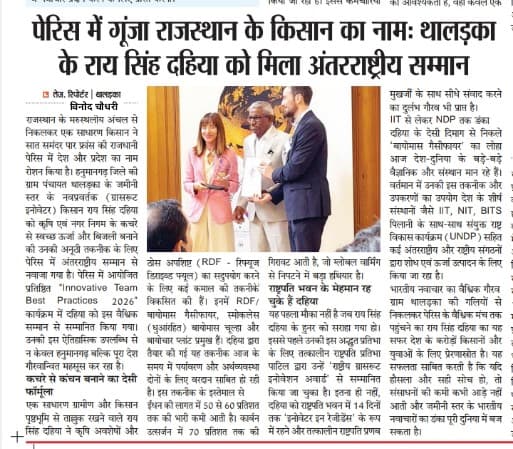
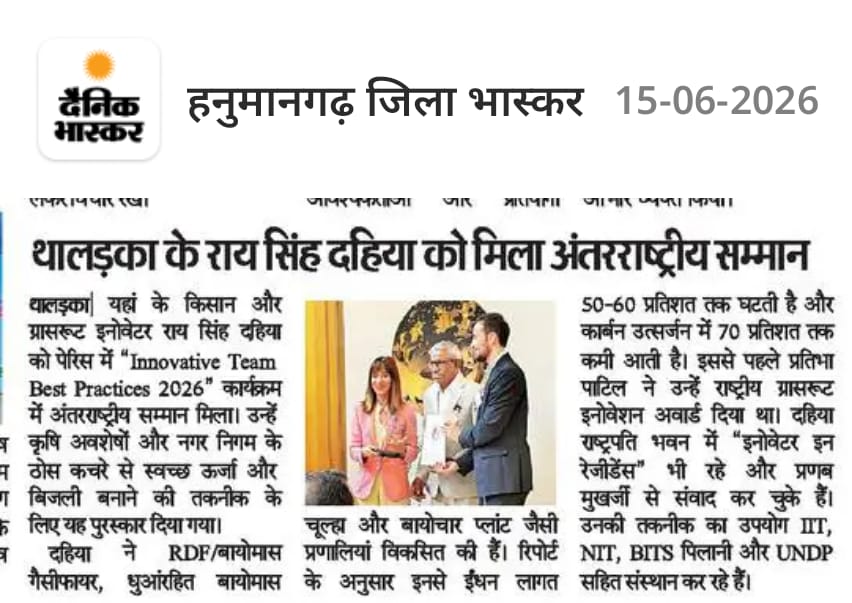
Great recognition has come from Paris for a grassroots innovator from the fields of Rajasthan. Rai Singh Dahiya, founder of Enersol Biopower Pvt. Ltd., has been honoured with the Innovation Team Best Practices 2026 award at an international forum in Paris — a milestone that brings global attention to India's quiet revolution in clean biomass energy.
Dainik Bhaskar, one of India's largest Hindi dailies, featured the story prominently, calling it a proud moment for Rajasthan and for Indian innovation at large. The coverage highlighted how a man who grew up farming the soil of Rajasthan went on to develop technologies that are now recognised on an international stage.
Why waste something that can become energy?
From the Fields of Rajasthan
Rai Singh Dahiya's story begins not in a laboratory but in the agricultural heartland of Rajasthan. As a young farmer, he witnessed firsthand the twin burdens his community faced: mountains of crop residue being burned openly, and the ever-rising cost of LPG and diesel for cooking and heating. Rather than accepting these as fixed realities, he asked a deceptively simple question — could waste become fuel?
That question led to years of self-driven experimentation, prototyping, and refinement. Without access to research grants or institutional support, he built his first biomass gasifier using practical knowledge and persistence. The result was a working machine that converted agricultural waste — paddy husk, wood chips, sugarcane bagasse — into usable producer gas for heat and electricity generation.
Enersol Biopower — Turning Waste Into Energy
From these roots grew Enersol Biopower Pvt. Ltd., based in Jaipur, Rajasthan. The company today manufactures four core clean-energy products: the Biomass Gasifier (2kW to 250kW), capable of powering rice mills and agro-industries on farm waste; the Smokeless Biomass Stove, which replaces costly LPG in commercial kitchens, dhabas, and sweet shops; the Biogas Genset (2kVA to 100kVA), which converts organic waste into electricity; and the Biomass Pyrolysis Plant, which transforms waste into biochar and bio-oil for soil health and industrial use.
Each product addresses a concrete, everyday problem faced by India's rural and semi-urban economy. Together, they form a coherent vision: make biomass waste a resource, not a burden. Enersol's impact extends well beyond Rajasthan — completed projects at IIT Ropar, NIT Tiruchirappalli, and through international UNDP programmes in Yemen and Ghana stand as evidence of that reach.
True innovation comes from understanding a problem deeply and having the courage to solve it.
Paris 2026 — A Global Honour for Indian Grassroots Innovation
The Paris recognition marks the latest chapter in this journey. The Innovation Team Best Practices 2026 award, presented at an international innovation forum in Paris, recognises individuals and teams whose work demonstrates outstanding real-world impact. That Rai Singh Dahiya and Enersol Biopower have been chosen reflects a growing global acknowledgement that clean energy solutions for the developing world cannot always come from Silicon Valley — sometimes they must come from the soil itself.
Dainik Bhaskar's coverage captured the pride that rippled through Rajasthan on the news. For a state known for its agricultural traditions, seeing one of its own honoured on an international stage for turning agricultural waste into clean energy carried a particular resonance.
A Message to the Next Generation
For those who ask how a grassroots innovator from a farming background reached Paris, Dahiya's own journey provides the clearest answer: you do not need to come from a metropolis, and you do not need a large research budget. You need observation, persistence, and the refusal to accept that waste must stay waste.
Enersol Biopower continues to carry that vision forward — designing, manufacturing, and deploying bioenergy systems that serve farmers, industries, and communities. The Paris award is not a conclusion. It is, as those familiar with the company note, simply the latest milestone on a much longer road.
Enersol Biopower
Explore the Clean Energy Technologies Behind the Award
From biomass gasifiers to pyrolysis plants — practical innovation built on real problems.
Get Free Consultation