
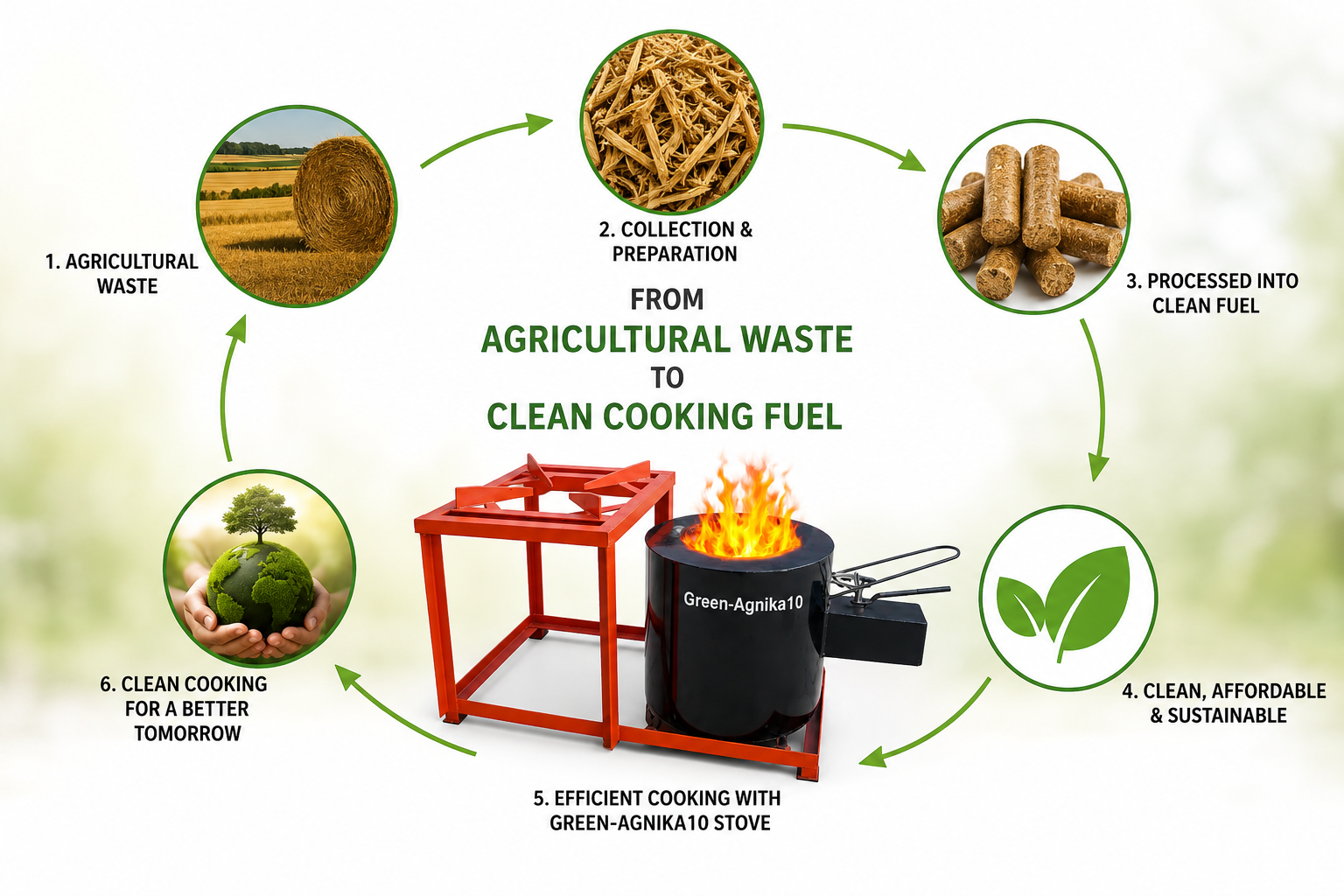
Key Highlights
- India generates 686 million tonnes of agricultural residue per year
- 4 proven processes convert agro-waste into cooking fuel: combustion, gasification, pelletisation, biogas
- Forced-draft biomass stoves achieve 55–72% efficiency vs 8–12% for open fires
- Biomass cooking fuel costs 60–70% less than LPG for the same heat output
- Burning waste biomass is carbon-neutral per IPCC classification
Every harvest season, India's 150 million farming households are left with a problem: mountains of crop waste they cannot use, cannot sell, and cannot simply leave on the field. Paddy straw, wheat stubble, sugarcane tops, cotton stalks, mustard stalks — collectively, India generates over 686 million tonnes of agricultural residue every year.
Most of it gets burned. That open burning costs India an estimated ₹15,000 crore annually in health damages and releases carbon equivalent to millions of cars driven for a year.
But here is what most people do not know: the same agricultural waste being burned as a problem can be transformed into clean cooking fuel — one that replaces expensive LPG, eliminates smoke, and costs less per meal cooked. This article explains exactly how.
What Is Agricultural Waste as Cooking Fuel?
📚 Definition (Featured Snippet Target)
Agricultural waste is converted into cooking fuel by drying and feeding crop residue — such as paddy straw, sugarcane bagasse, rice husk, or wood chips — into a biomass combustion system. When burned in a controlled, forced-draft biomass stove or converted through gasification, the stored solar energy in the organic material is released as heat for cooking. The process eliminates smoke and cuts fuel costs by 50–70% compared to LPG.
Agricultural waste is organic plant matter left after harvesting. It contains stored solar energy — the same energy the plant absorbed from sunlight during its growth cycle. When processed correctly and burned in the right equipment, it releases that energy as heat.
The key difference between traditional open burning (which wastes 90% of energy as smoke and heat loss) and biomass cooking technology (which captures 60–80% for cooking) is engineering — the design of the combustion chamber, the airflow, and the fuel feeding system.
Which Agricultural Wastes Can Be Used as Cooking Fuel?
India has extraordinary diversity in agricultural residue. Here are the most common types and their energy properties:
| Agro Waste | Calorific Value | Best Use | Where Available |
|---|---|---|---|
| Paddy Straw (Parali) | 14–15 MJ/kg | Pellets, gasifier feedstock | Punjab, Haryana, UP, WB |
| Sugarcane Bagasse | 17–19 MJ/kg | Stoves, gasification | Maharashtra, UP, Karnataka |
| Rice Husk | 13–14 MJ/kg | Gasifier, direct combustion | All rice-growing states |
| Wood Chips / Sawdust | 16–19 MJ/kg | Biomass stoves, gasifiers | All states (timber industry) |
| Cotton Stalks | 15–17 MJ/kg | Direct fuel, pellets | Maharashtra, Telangana, AP |
| Mustard / Groundnut Stalks | 14–16 MJ/kg | Biomass stove, pellet feedstock | Rajasthan, MP, Gujarat |
| Coconut Shell / Husk | 19–21 MJ/kg ★ | Premium stove fuel | Kerala, Tamil Nadu, Karnataka |
★ Highest calorific value among common agro-wastes
How Agricultural Waste Is Transformed: 4 Main Processes
The conversion of raw agro-waste into clean cooking fuel happens through four distinct technology pathways:
Direct Combustion in Forced-Draft Biomass Stoves
- Agricultural residue (loose straw, wood chips, rice husk) loaded into the fuel chamber
- Forced-draft fan pushes precisely calibrated airflow through the fuel bed
- Primary air enters from below, enabling efficient combustion at the base
- Secondary air burns off smoke gases before they escape — near-zero visible smoke
- Result: clean, high-temperature flame similar to a gas burner
Gasification — Converting Solid Waste to Clean Gas
- Dry agricultural residue fed into top of gasifier reactor
- Controlled, limited oxygen introduced — partial combustion only
- Temperatures of 700–1,000°C generated inside the reactor
- Carbon reacts with CO₂ and H₂O vapour → produces producer gas (CO + H₂ + CH₄)
- Producer gas cooled, filtered, and burned as clean gaseous fuel — behaves like LPG
Pelletisation — Compressing Waste Into Premium Fuel
- Loose agro-residue dried to below 12% moisture
- Ground into fine particles using a hammer mill
- Compressed under high pressure through a die — natural lignin acts as glue, no binder needed
- Result: dense cylindrical pellets with 5–6× energy density of loose biomass
Biogas Production — Wet Waste to Cooking Gas
- Wet organic material (cattle dung, kitchen waste, press mud) mixed with water
- Slurry fed into a sealed anaerobic biogas digester
- Microorganisms break down organic matter without oxygen
- Breakdown produces biogas (55–70% methane + CO₂)
- Biogas piped to kitchen burners — burns with clean blue flame
Why India Is Turning Agro-Waste Into Cooking Fuel
LPG Costs Are Rising Unsustainably
Commercial LPG now costs ₹900–1,100 per cylinder. A hotel using 20–30 cylinders/month spends ₹25,000–35,000 on fuel alone. Biomass cooking fuel from local agro-waste reduces this by 60–70%.
Stubble Burning Must Be Stopped
The Supreme Court and NGT mandate a ban on paddy stubble burning. But without an economic alternative, farmers continue. Biomass fuel creates a market demand for stubble — paying farmers for what they previously burned.
Rural Areas Lack Reliable LPG Supply
Over 180 million rural households face irregular LPG supply and high transport costs. Local agricultural waste is available year-round, making it a far more reliable cooking fuel source.
MNRE's National Bioenergy Programme
MNRE targets deploying 5 lakh biomass-based cooking systems and achieving 10 GW of biomass power by 2030. Subsidies and institutional support actively promote agro-waste to energy conversion.
Key Benefits of Using Agricultural Waste as Cooking Fuel
Zero Disposal Cost
Waste that previously cost money to dispose becomes revenue-generating fuel
60–70% Lower Fuel Cost
Vs LPG for the same heat output — proven across 500+ Enersol installations
Carbon-Neutral
Releases only the CO₂ the plant absorbed while growing — IPCC certified
Near-Zero Smoke
In engineered biomass stoves — cleaner than many urban LPG kitchens
Locally Available
No supply chain delays, no price volatility, no foreign exchange outflow
Farmer Income
Creates new revenue streams for agricultural communities from waste they previously burned
How Enersol Biopower Converts Agro-Waste Into Clean Cooking Fuel
Rai Singh Dahiya, Founder of Enersol Biopower, developed India's first forced-draft biomass stove designs specifically to handle the agro-waste available in Rajasthan — mustard stalks, wood chips, and sugar residue — without pre-processing. This innovation earned him the Fifth National Grassroots Innovation Award (2009), recognition at Rashtrapati Bhavan (2015), and the Paris Innovation Team Best Practices 2026 award.
| Application | Enersol Product | Agro-Waste Used | Who Uses It |
|---|---|---|---|
| Home cooking | Household Biomass Stove | Wood chips, stalks, pellets | Rural households |
| Hotel / dhaba kitchen | Green-Agnika to Jumbo-Shakti36 | Rice husk, bagasse, wood chips | Hotels, restaurants, dhabas |
| School / hostel kitchen | Institutional Biomass Stoves | Loose agro-waste or pellets | Schools & hostels (50–5,000 students) |
| Industrial heat + power | Biomass Gasifier 2–250 kW | Rice husk, paddy straw, bagasse | Agro-industries, rice mills |
| Off-grid electricity | Biogas Genset | Cattle dung, kitchen waste | Dairy farms, villages |
Frequently Asked Questions
Conclusion
The transformation of agricultural waste into clean cooking fuel is not a futuristic concept. It is happening today — in hotel kitchens in Rajasthan, school hostels in Maharashtra, rice mills in Andhra Pradesh, and community kitchens funded by UNDP in Yemen and Ghana.
The technology works. The fuel is available. The economics are compelling. What remains is awareness — and machines designed to make it practical. At Enersol Biopower, we are building that bridge, one biomass stove, one gasifier, one community at a time.

About the Author
Rai Singh Dahiya
Founder & Chief Innovator, Enersol Biopower Pvt. Ltd.
Grassroots innovator and recipient of India's Fifth National Grassroots Innovation Award (2009). Selected as Innovation Scholar-in-Residence at Rashtrapati Bhavan (2015). Honoured with the Paris Innovation Team Best Practices 2026 award. Over 25 years of experience pioneering clean biomass energy solutions deployed at IITs, NITs, and in UNDP international projects across Africa and the Middle East.