

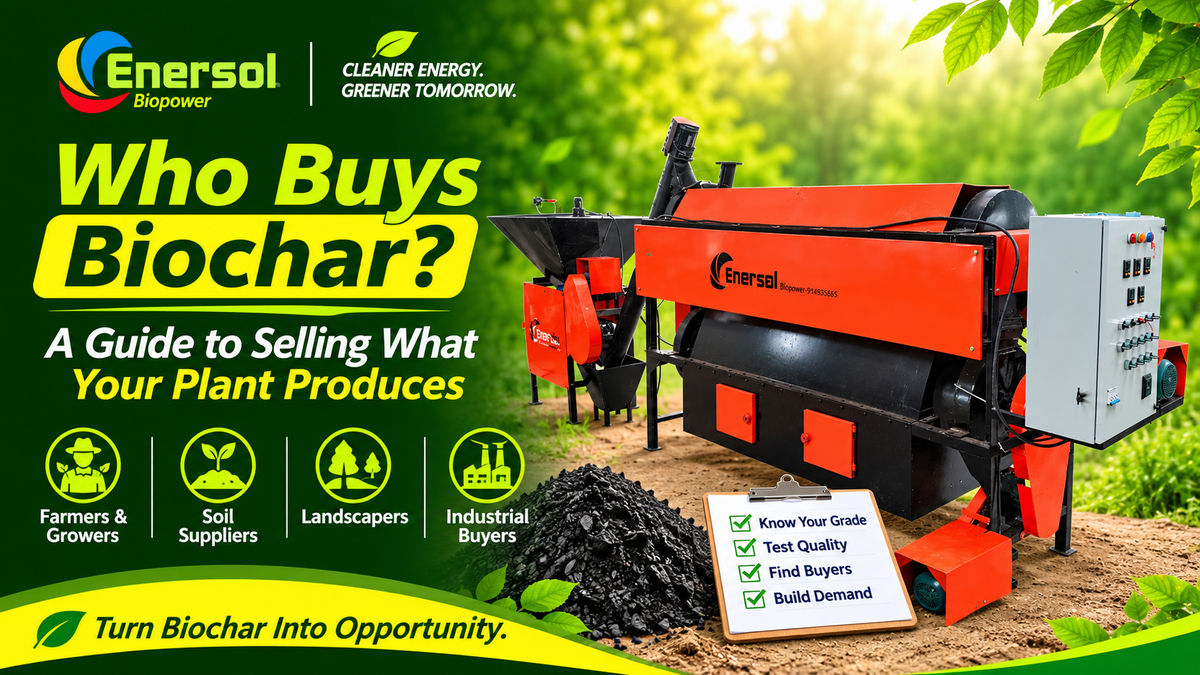
Who Buys Biochar? A Guide to Selling What Your Plant Produces
In India, biochar is mainly bought by farmers, nurseries, compost makers and carbon project developers, with some industrial users on top. Each buyer wants different quality and pays a different price, so the smartest investors choose their market first and design their plant around it.
By Rai Singh Dahiya, Founder, Enersol Biopower | Published 21 October 2026
Key Article Highlights
- Choose your buyer before you finalise your plant size and feedstock
- There is no single biochar price, and published estimates differ widely
- A lab report is your best sales tool
- Blended products can reach farmers more easily than plain biochar
- Carbon credits can add income, but treat them as a bonus until you have a signed deal
Why You Should Find the Buyer First
Many plant projects start with the question, "How much biochar can I make?" The better question is, "Who will buy it, at what price, and how often?"
India's biochar market is still young. Many farmers have not used it, and few buyers purchase on a regular schedule. That is an opportunity, but it also means that you may have to build your own demand.
Your buyer affects your feedstock, process temperature, grading, packaging and plant size. If you decide that first, you can avoid building a plant for a market that does not exist nearby.
Who Buys Biochar?
These are the main buyer groups, roughly from the easiest to reach to the hardest to qualify for.
1. Farmers and Farmer Groups
This is the largest potential market, and the most price-sensitive. Farmers want to see results on a local crop first. Farmer Producer Organisations can buy in larger quantities and spread the word. Sell near your plant to keep transport costs down.
2. Nurseries, Orchards and Horticulture
High-value plants can justify a higher input cost. Nurseries and potting mix makers want clean, well-graded, consistent material. Orders may be smaller, but they often repeat.
3. Compost and Organic Input Makers
These businesses can blend biochar into their existing products and sell it through channels they already have. One good customer here can take steady monthly volumes, so they are worth approaching early.
4. Industrial Users
Filtration, cement, metals and similar sectors are possible buyers, but they usually set strict limits on carbon, ash, moisture and size. They also expect a reliable supply. Ask for their specification before you promise anything, because many will need further processing.
5. Carbon Project Developers and Export Buyers
These buyers care about verified quality and traceable records. Export buyers may ask for a recognised certificate. They offer larger opportunities, but they take the longest to qualify for. See the carbon credits section below.
What Quality Do Buyers Want?
Biochar is not one product. Quality depends on your feedstock and how you make it. A lab report shows buyers what they are getting, and it lets you compare your batches over time.
| Test | Why Buyers Care |
|---|---|
| Carbon content | The basic measure of value for many buyers |
| H/Corg ratio | Shows stability. EBC and IBI both use a maximum of 0.7 |
| Ash | High ash lowers carbon and can rule out industrial use |
| Moisture | Buyers do not want to pay for water |
| pH | Decides which soils and crops it suits |
| Particle size | Affects handling, blending and end use |
| PAH and heavy metals | Safety checks for soil, food crops and certification |
Keep your feedstock clean, and avoid treated wood, painted wood and contaminated waste. Keep records of each batch as well, including feedstock, date, temperature and weight. For the agricultural classes in the European Biochar Certificate, limits for PAHs and metals are stricter, so check the current version if you plan to export. Also ask your state agriculture department or an adviser which Indian rules apply before you sell biochar as a soil product.
What Price Can You Expect?
There is no published market rate for biochar in India. Estimates range from about ₹5 to ₹40 per kg, and they do not always compare the same grades or the same stage of sale. Treat them as a starting point only.
Here is a simple way to test your numbers. It uses an illustrative plant that processes 100 kg of biomass an hour for 8 hours a day and 25 days a month, at a yield of 25–35%.
At ₹8–25 per kg, that output would bring in about ₹40,000–₹1,75,000 a month before any costs. That wide range is the reason to get real quotes before you invest.
Then subtract biomass, labour, power, maintenance, testing, packaging and transport. Add any income from your plant's other outputs, or from using its heat. Our project planning guide covers the plant side of this.
How to Win Your First Customers
Handling: Cool biochar fully before storage, because hot material can reignite. Keep it dry, and control dust during packing and transport. Lightly dampening it can help with dust, but buyers should know the moisture level in what they pay for.
Carbon Credits: A Realistic Look
Biochar locks carbon into a stable form, so buyers in the voluntary carbon market will pay for the verified removal. Puro.earth and Isometric are two of the registries with biochar methodologies. This is real income for some projects, but it is not automatic.
Recent market reports show many biochar credits at about $100–$200 per tonne of CO₂, while India-linked deals and indications have been reported lower, at about $80–$140. Prices are moving, and developers have reported long-term deals under $100, so check current offers.
What You Need Before You Count the Income
- A methodology: Your plant, feedstock and end use must meet the rules of a recognised standard.
- Measured data: Expect detailed records of feedstock, energy use, output and where the biochar ends up.
- Verification: An independent auditor checks your claims, and that has a cost.
- Proof of use: You generally need to show that the biochar was stored in soil or another approved use.
- A buyer: Credits have value only when someone signs to buy them.
For a small plant, these costs can be heavy. Many producers will do better by joining a project developer or a group of plants. Build your business so that it works on product sales alone, and treat credit income as an upside until you have a signed agreement.
Frequently Asked Questions
Who buys biochar in India?
The main buyers are farmers and farmer groups, nurseries, compost and organic input makers, and carbon project developers. Some industrial users, such as filtration, cement and metals businesses, may also buy, but they usually want higher and more consistent quality.
What is the price of biochar in India?
There is no single market price. Published estimates range from about ₹5 to ₹40 per kg, and they do not always compare the same grades. Your price depends on quality, feedstock, volume, packaging and buyer. Get written quotes from real buyers before you plan your project.
Can a small biochar plant earn carbon credits?
It may be possible, but it is not automatic. Credits need an approved methodology, measured data, third-party verification and a credit buyer. Those costs can be heavy for one small plant, so many producers work through a project developer or as part of a group.
What tests does a biochar buyer ask for?
Buyers commonly ask for carbon content, ash, moisture, pH, particle size and the feedstock used. Serious agricultural, export and carbon buyers may also want H/Corg ratio, PAH and heavy metal results. Under EBC and IBI, H/Corg should not exceed 0.7.
Is rice husk biochar good for selling?
It can suit soil and horticulture uses, but rice husk has high ash, which lowers its carbon content. That can limit its use for buyers who need high-carbon material. Test each feedstock and match it to the right buyer.
Should I find buyers before I build a biochar plant?
Yes. Identify your buyers, their quality needs and their likely price before you finalise your plant. If you can, make trial samples and secure written interest or a supply agreement, because your market should shape your plant size and feedstock.
Planning a Biochar Plant?
Tell us your biomass, your daily quantity and the market you have in mind. Our team will help you plan a plant around your buyers.
Talk to Our Team →
Recipient of India's Fifth National Grassroots Innovation Award (2009), invited as Innovation Scholar-in-Residence at Rashtrapati Bhavan (2015). Over 25 years of experience designing biomass energy technology for rural India.