

Biomass Gasifier Troubleshooting and Maintenance Guide
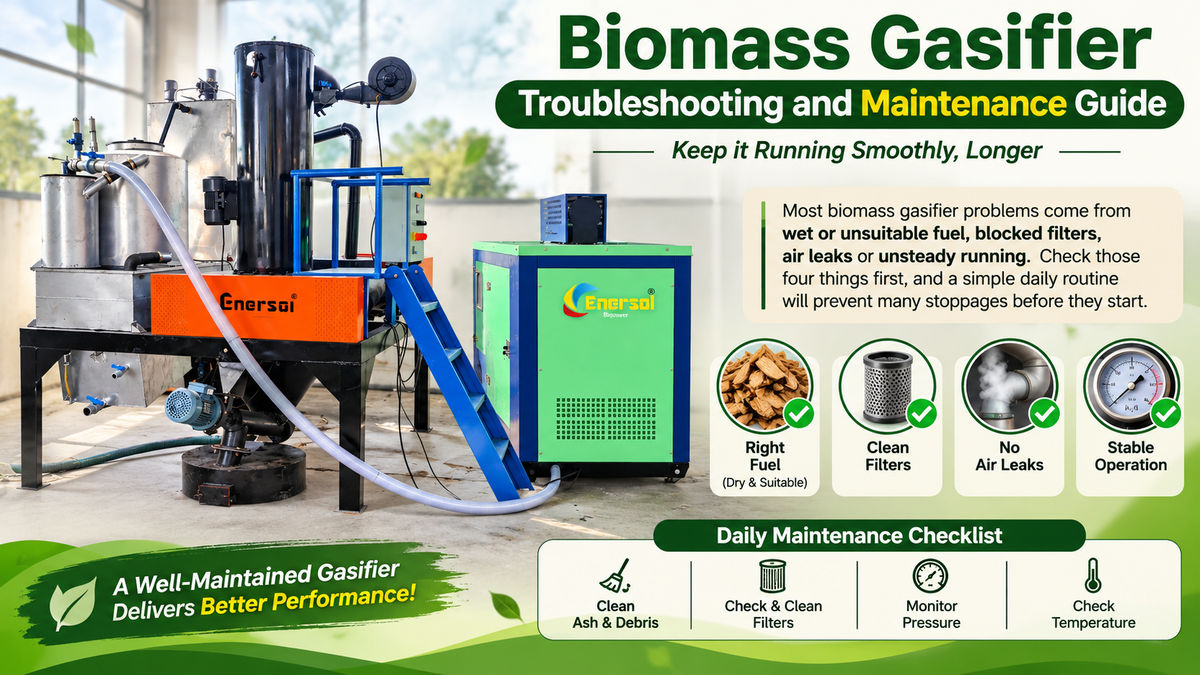
Most biomass gasifier problems come from wet or unsuitable fuel, blocked filters, air leaks or unsteady running. Check those four things first, and a simple daily routine will prevent many stoppages before they start.
By Rai Singh Dahiya, Founder, Enersol Biopower | Published 3 October 2026
Key Article Highlights
- Check fuel, filters, leaks and load before you suspect a major fault
- Tar usually means the reactor is running too cool
- Keep fuel moisture below 20%
- Use the daily, weekly and monthly checklist to catch problems early
- Producer gas contains carbon monoxide, so safety comes before every repair
Safety First: Before You Touch the Plant
Producer gas is flammable, and it contains carbon monoxide. This gas is poisonous and you may not notice it until it has already affected you. Treat every gas-side job as a safety job.
Follow These Rules Every Time
- Ventilation: Run the plant only in a well-ventilated area, and fit a carbon monoxide alarm near it.
- Shutdown: Stop, cool and purge the system as your manual directs before opening any gas-side part.
- Ignition sources: Keep flames, sparks and smoking away from the plant and its fuel store.
- Protection: Wear gloves and eye protection, and treat the reactor and pipes as hot until proven cool.
- Working alone: Do not enter an enclosed space around the plant alone. If you feel a headache, dizziness or nausea, move to fresh air at once and get medical help.
Quick Troubleshooting Table
Find your symptom here, then read the matching section below for more detail. Always start with the simplest cause.
| Symptom | Likely Cause | First Action |
|---|---|---|
| Tar in pipes or filters | Cool reactor, wet fuel, low load | Check fuel moisture and running load |
| Low gas or weak flame | Wet fuel, bridging, blocked filter, air leak | Check fuel flow, then filters and seals |
| Gas will not light | Reactor not hot enough, air in the gas, wet fuel | Allow more warm-up, check for leaks |
| Engine loses power | Poor gas, blocked air or gas path, overload | Reduce load, check filters and gas quality |
| Engine hunts or misfires | Unsteady gas supply, ignition fault, wrong air-gas mix | Check spark plugs and mixture setting |
| Fuel stops moving down | Bridging in the hopper | Clear it using the method in your manual |
| Hard lumps in the reactor | Clinker from high-ash fuel or hot spots | Check ash content and air flow |
| Pressure drop keeps rising | Filter or pipe blockage | Inspect and clean the gas path |
Common Gasifier Problems and How to Fix Them
1. Tar Build-Up
Tar forms when the reactor is not hot enough to break down the vapours from the fuel. You will see sticky deposits in pipes and filters, and over time it can reach the engine.
Fix: Dry your fuel, run at a steady load and avoid frequent stops and starts. Clean the affected parts as your manual directs. If tar keeps returning on dry fuel, ask a technician to check reactor temperature.
2. Low Gas Output or Weak Flame
Moisture takes heat away from the reaction, and a blocked filter restricts flow. An air leak can also dilute the gas, so you get more volume but less energy.
Fix: Test the fuel, confirm that it is moving down, and check the filters. Then check doors, seals and pipe joints for leaks using the method in your manual.
3. Gas Will Not Light
After a start, the reactor needs time to reach working temperature. Until then the gas can be too weak to burn. Wet fuel makes this much slower.
Fix: Give the plant its full warm-up time and check the fuel. On models with automatic ignition, also check the ignition system. Never use a shortcut, and never hold an open flame near a gas outlet outside your manual's procedure.
4. Engine Loses Power or Misfires
Gas quality and load are the first things to check. If they look normal, the fault may be in the ignition system, because Enersol's gas engines use spark ignition.
Fix: Reduce the load and check the air and gas filters. Then inspect the spark plugs and the air-gas mixture setting. If the engine is often overloaded, compare the right capacity in our biomass gasifier range.
5. Fuel Bridging
Bridging happens when fuel locks together in the hopper and stops falling into the reactor. Long, uneven or light pieces cause it most often. Gas output drops even though the hopper looks full.
Fix: Clear it using the procedure in your manual. To prevent it, keep your fuel size even and use fuel with a bulk density above 200 kg/m³, as listed for the 8 kW model. Briquettes or pellets can help with loose residues.
6. Clinker Formation
Clinker is ash that has melted and set into hard lumps. It can block gas flow and stop ash from falling away.
Fix: Remove it when the plant is shut down and cool. Check the ash content of your fuel, since the 8 kW specification lists less than 5%. Also look for uneven air flow, which can create hot spots.
Fuel Quality: The Cause Behind Many Faults
If you fix one thing, fix your fuel. These are the fuel requirements listed for Enersol's 8 kW gasifier. Check the figures for your own model.
Store fuel under cover and off the ground, especially in the monsoon. A low-cost moisture meter can pay for itself by catching wet fuel before it reaches the hopper. Change your fuel type only after checking that it suits your gasifier.
Daily, Weekly and Monthly Maintenance Checklist
Use this as a general routine. Your plant's manual and running hours take priority, and heavy-duty use may need shorter intervals.
Daily
- Check fuel moisture and stock
- Remove ash as directed
- Note gauge and temperature readings
- Look and listen for leaks
- Check engine oil and coolant
- Test the carbon monoxide alarm
Weekly
- Inspect and clean gas filters
- Clean the cyclone and dust collection points
- Check door seals and pipe joints
- Inspect blower and fan belts
- Clean the engine air filter
- Review the week's log for changes
Monthly
- Inspect the reactor and grate when cool
- Check gas pipes for deposits
- Inspect spark plugs
- Test sensors and safety devices
- Check electrical connections
- Plan any parts you will need
Enersol's power gasifiers up to 24 kW list dry filtration, so the routine on those models focuses on cleaning filters and removing dust. The 10 kW, 12 kW and 24 kW models also list the patented RS Filter, which helps with tar control and longer filter life. Clean each filter as your model's manual directs.
Keep a Simple Operator Log
A single page each day can show a problem long before it stops your plant. Your technician will also be able to find faults much faster.
- Fuel type, moisture and quantity used
- Running hours and load
- Temperature and pressure readings
- Filter cleaning dates and how dirty they were
- Faults, stoppages and what fixed them
When to Call a Technician
Operators can handle routine checks, but some problems need trained support. Stop the plant safely and call for help if you see any of these:
- A carbon monoxide alarm, or a suspected gas leak you cannot isolate
- A problem that returns after you have checked fuel, filters and leaks
- Repeated overheating or an abnormal reactor temperature
- Cracks or damage to the reactor or its lining
- Tar reaching the engine
Frequently Asked Questions
What causes tar in a biomass gasifier?
Tar usually forms when the reactor runs too cool. Common causes are wet fuel, long periods at low load, frequent stops and starts, and fuel that does not suit the gasifier. Dry fuel, steady load and clean filters are the best ways to keep tar under control.
Why is my biomass gasifier producing low gas?
Low gas output is most often caused by wet fuel, fuel bridging in the hopper, a blocked filter or an air leak. Check fuel moisture first, then confirm that fuel is flowing down freely. After that, check the filters and all seals and joints.
How often should a biomass gasifier be maintained?
Basic checks such as fuel, ash, gauges and leaks should be done every day. Filters and gas lines are usually checked weekly, with deeper checks of the reactor, blower and engine each month. Your manual and running hours set the exact schedule.
What fuel moisture is best for a biomass gasifier?
Keep fuel moisture below 20%. Enersol's 8 kW gasifier also lists a minimum calorific value of 3,600 kcal/kg, bulk density above 200 kg/m³ and ash below 5%. Requirements can differ by model, so check the specification for your system.
Is producer gas dangerous?
Yes. Producer gas contains carbon monoxide, which is poisonous and has no smell of its own, and the gas is flammable. Run the plant in a well-ventilated area, fit a carbon monoxide alarm, keep flames away from leaks and never open gas-side equipment until the plant is shut down, cooled and purged as your manual directs.
When should I call a gasifier technician?
Call a technician if a problem returns after you have checked fuel, filters and leaks. Also call if you find a suspected gas leak you cannot isolate, a repeated overheating alarm, or damage to the reactor or its lining. Do not bypass safety devices to keep the plant running.
Need Help with Your Gasifier?
Tell us your model, your fuel and the problem you are seeing. Our team can help you with troubleshooting, operator training and maintenance support.
Talk to Our Team →
Recipient of India's Fifth National Grassroots Innovation Award (2009), invited as Innovation Scholar-in-Residence at Rashtrapati Bhavan (2015). Over 25 years of experience designing biomass energy technology for rural India.