

Myth vs Fact: What People Get Wrong About Biomass Gasifiers
Most problems blamed on biomass gasifiers come from wet fuel, the wrong size or a missing routine, not from the technology itself. Here are 10 common myths about gasifiers and the facts that buyers and operators should know instead.
By Rai Singh Dahiya, Founder, Enersol Biopower | Published 06 November 2026
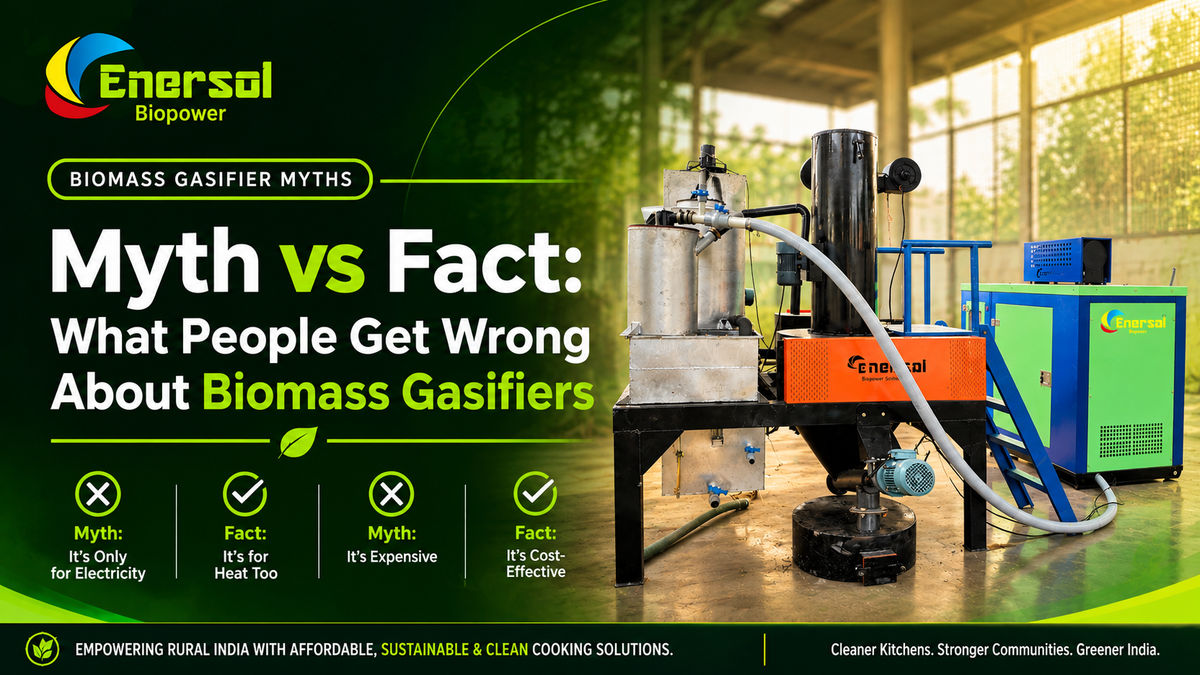
The Short Version
- Fuel: Dry fuel matters more than almost anything else. Keep moisture below 20%.
- Tar: It is a sign of a cool or badly run reactor, not something every gasifier must suffer.
- Size: Small gasifiers suit villages, institutes and small industries, not only big plants.
- Uses: Gasifiers make heat as well as electricity.
- Safety: The risks are real but well understood, and a simple routine controls them.
Why Gasifiers Attract So Many Myths
Few people have seen a biomass gasifier up close, so most of what they hear comes second-hand. One badly run plant, one bag of wet fuel or one engine full of tar can turn into a story that follows the whole technology around.
After more than 25 years of building gasifiers in Jaipur, we hear the same doubts again and again. Here are the ten we hear most, and what is actually true.
10 Myths at a Glance
| Myth | Fact |
|---|---|
| A gasifier just burns biomass | It turns biomass into a fuel gas with limited air |
| Any biomass will do, wet or dry | Fuel must be dry and of a suitable size |
| Gasifiers always ruin engines with tar | Tar comes from a cool reactor and is controllable |
| Gasifiers are smoky and polluting | The gas burns in an engine or burner, not in the open |
| It is outdated technology | Modern designs are used by research institutes today |
| Only big plants make sense | Small gasifiers suit villages, institutes and small units |
| Gasifiers only make electricity | Thermal gasifiers supply process heat |
| Any engine can run on producer gas as it is | The engine must be matched to producer gas |
| A gasifier runs itself | It needs a trained operator and a daily routine |
| Gasifiers are too dangerous | The risks are known and controllable |
The Myths, One by One
Myth 1: A gasifier is just a fancy way of burning biomass
Fact: Burning turns biomass into heat, ash and smoke in one step. A gasifier heats biomass with only a limited supply of air, so instead of burning away the fuel turns into producer gas, a combustible mix that mainly contains carbon monoxide, hydrogen and methane along with nitrogen. That gas is cleaned and then burned where you need it, in an engine for electricity or a burner for heat.
Myth 2: Any biomass will work, wet or dry
Fact: A gasifier is fussy about two things: moisture and size. Wet fuel takes heat away from the reaction, which weakens the gas and adds to tar. Keep moisture below 20% and store fuel under cover. Pieces that are too fine or too large can block the reactor or let air channel through it. Rice husk, wood chips, crop residue, coconut shells and pellets can all work, but each needs the right design, so ask your supplier to check your fuel before you buy.
Myth 3: Every gasifier fills the engine with tar
Fact: Tar is a symptom, not a fixed feature. It usually forms when the reactor runs too cool, for example with wet fuel, long periods at low load or frequent stops and starts. Dry fuel, steady running and proper gas cleaning keep it under control. Enersol's ESB-R10, for example, uses dry filtration with the patented RS Filter. Our troubleshooting guide explains how to diagnose and reduce tar.
Myth 4: Gasifiers are smoky and polluting
Fact: In a gasifier the fuel is converted inside a closed reactor, and the gas is burned in an engine or burner, not left to smoulder in the open. Compare that with the usual fate of crop residue in India: much of it is burned in the fields, releasing smoke and fine particles. Turning that same residue into fuel puts it to work instead, and it can replace diesel, LPG or furnace oil.
Myth 5: Biomass gasification is outdated technology
Fact: The basic idea is old, but today's gasifiers are not. Modern systems have better reactor design, gas cleaning and controls. Research institutions still study and use them: Enersol has supplied gasifiers to IIT Ropar, NIT Tiruchirappalli and KNUST in Ghana. Read the story of the 10 kW gasifier at IIT Ropar.
Myth 6: A gasifier only makes sense for a big plant
Fact: Gasifiers come in many sizes. Enersol's 10 kW ESB-R10 is listed as a fit for villages, research institutions and small-scale industries. The right size depends on your running load and hours, not on how big your business is. See our biomass gasifier range to compare capacities.
Myth 7: Gasifiers only make electricity
Fact: Power gasifiers feed producer gas to an engine. Thermal gasifiers send it straight to a burner, dryer or furnace, which is often the simpler and more efficient use. Many factories use gasifiers to replace LPG, diesel or furnace oil for heat. Learn more in our guide to biomass gasifiers for process heat.
Myth 8: Any engine can run on producer gas as it is
Fact: Producer gas has less energy than diesel or natural gas, and it behaves differently in an engine. The engine and its settings must be matched to the gas. The ESB-R10, for instance, uses a spark ignition engine. When you compare offers, ask who supplies the engine and whether it is set up for producer gas.
Myth 9: Once installed, a gasifier runs itself
Fact: A gasifier needs an owner. Every day someone should check fuel, ash, gauges and leaks. Every week, the filters and gas lines. Every month, the reactor, blower and engine in more depth. Sites that keep this routine, and a logbook, run far more reliably than sites that wait for a breakdown.
Myth 10: Gasifiers are too dangerous to have on site
Fact: Producer gas contains carbon monoxide and is flammable, so the risks are real. They are also well understood. An open, well-ventilated site, CO detectors, soapy-water leak checks, fire extinguishers and trained operators control them. Our gasifier safety guide covers each precaution and includes a daily checklist.
What Actually Decides How Well a Gasifier Runs
Strip away the myths and four things decide whether a gasifier is a good investment:
- The right fuel: dry, suitable and available all year.
- The right size: matched to your actual running load and hours.
- Good gas cleaning: to protect the engine or burner.
- A trained team: with a daily routine and someone responsible for it.
If you are comparing suppliers, our guide on how to choose a biomass gasifier manufacturer lists the 10 questions to ask.
Frequently Asked Questions
Can a biomass gasifier run on wet fuel?
Not well. Moisture takes heat away from the reaction and weakens the producer gas. Fuel for a gasifier should be dry, with moisture usually kept below 20%.
Do all biomass gasifiers produce a lot of tar?
No. Tar usually forms when the reactor runs too cool, for example with wet fuel, long periods at low load or frequent stops and starts. Dry fuel, steady running and good gas cleaning keep tar under control.
Is biomass gasification old technology?
The idea is old, but modern gasifiers use better reactor design, gas cleaning and controls. Research institutions such as IIT Ropar and NIT Tiruchirappalli use Enersol biomass gasifiers today.
Can a biomass gasifier provide heat as well as electricity?
Yes. Power gasifiers run an engine to make electricity, while thermal gasifiers send producer gas to a burner for drying, heating and other process heat.
Is a biomass gasifier safe to run?
Yes, when it is installed and run correctly. Producer gas contains carbon monoxide and is flammable, so a gasifier needs good ventilation, CO detectors, fire precautions and trained operators.
Still Have Doubts About Gasifiers?
Send us your fuel type and power or heat needs. We will give you a straight answer on whether a gasifier suits you.
Ask Our Team →
Recipient of India's Fifth National Grassroots Innovation Award (2009), invited as Innovation Scholar-in-Residence at Rashtrapati Bhavan (2015). Over 25 years of experience designing biomass energy technology for rural India.