

Every October and November, satellite images of northern India turn hazy with smoke. The cause is well-known: farmers burning paddy stubble after harvest. The same pattern repeats with mustard in spring, sugarcane in winter, and groundnut shells year-round.
This burning is not waste — it is a massive, untapped energy resource being destroyed in plain sight. India generates an estimated 500–700 million tonnes of agricultural residue every year. Of this, nearly 140 million tonnes is burned openly in fields — contributing to air pollution while destroying material that could power kitchens, factories, and rural homes cleanly and affordably.
The Scale of India's Agricultural Waste Problem
| Crop | Residue Type | Annual Volume |
|---|---|---|
| Rice / Paddy | Straw, husk | 140–160 million tonnes |
| Wheat | Straw | 80–100 million tonnes |
| Sugarcane | Bagasse, tops | 90–100 million tonnes |
| Mustard / Rapeseed | Stalks | 25–30 million tonnes |
| Groundnut | Shells, stalks | 15–20 million tonnes |
| Cotton | Stalks | 20–25 million tonnes |
The missed opportunity
Every tonne of paddy straw burned releases energy equivalent to 180–200 litres of diesel — destroyed in an open fire with zero useful output. Converting that same tonne into biomass pellets would produce 3–4 months of fuel for a commercial kitchen burner.
Which Farm Wastes Make the Best Fuel?
Not all agricultural waste performs equally as biomass fuel. The key parameters are calorific value, moisture content, and ash content.
| Biomass Type | Calorific Value | Ash Content | Best Use |
|---|---|---|---|
| Paddy husk | 3,200–3,600 kcal/kg | High (18–20%) | Gasifiers, boilers |
| Paddy straw pellets | 3,600–3,900 kcal/kg | Medium (10–13%) | Stoves, gasifiers |
| Mustard stalks | 3,900–4,200 kcal/kg | Low (5–7%) | Stoves — excellent briquettes |
| Groundnut shells | 4,000–4,400 kcal/kg | Low (3–5%) | Stoves, pellets |
| Cotton stalks | 3,800–4,100 kcal/kg | Medium (7–9%) | Briquettes |
| Wood sawdust | 4,200–4,600 kcal/kg | Low (1–2%) | Premium pellets |
Best combination for kitchen fuel: Mustard stalk and groundnut shell blends produce dense briquettes with high calorific value, low ash, and clean combustion — ideal for commercial kitchen stoves.
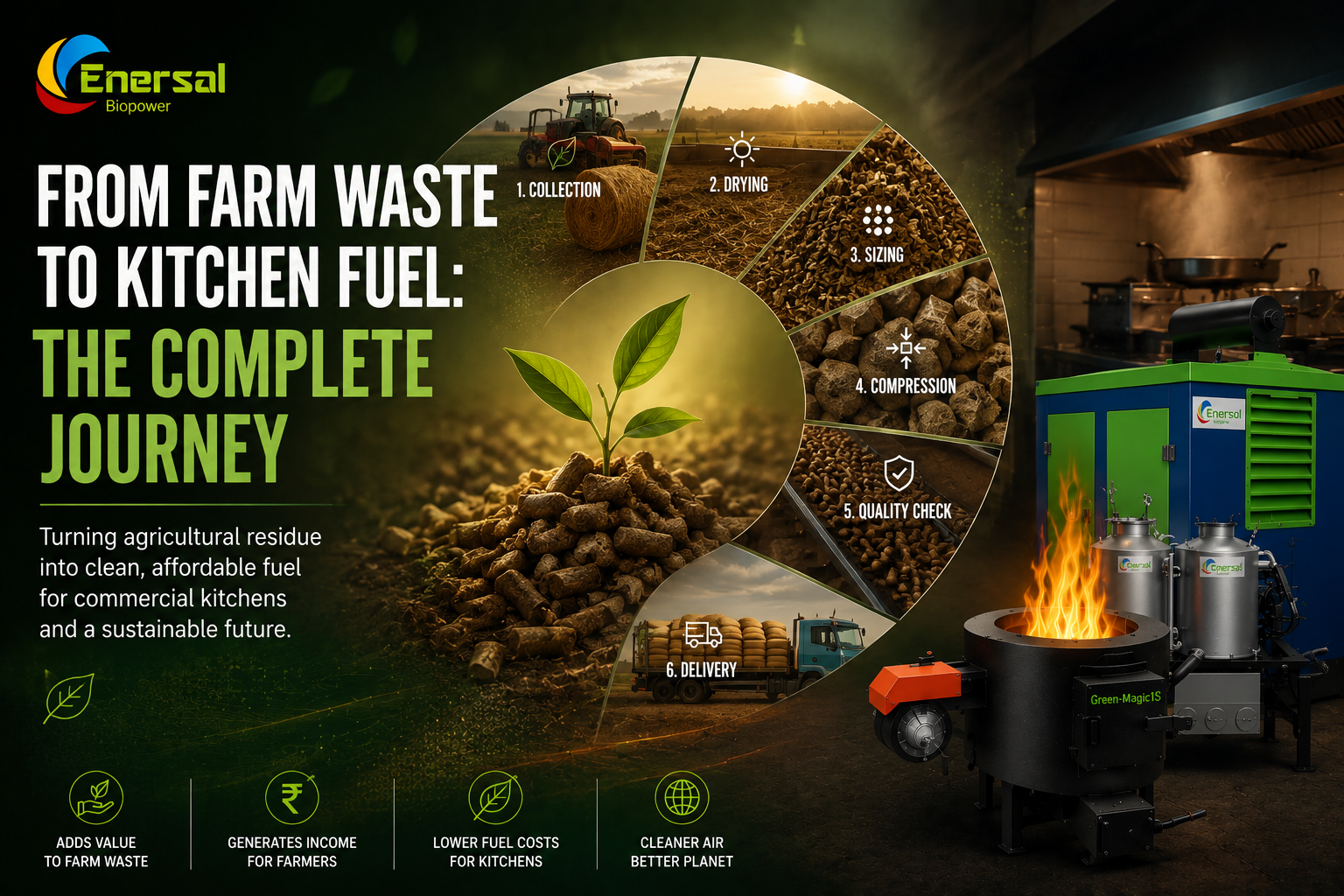
Step-by-Step: How Farm Waste Becomes Kitchen Fuel
Collection from the Farm
Farmers or aggregators gather crop residue after harvest. In organised supply chains, aggregators collect from 15–25 farm clusters, providing farmers ₹500–₹1,500 per tonne for material they would otherwise burn. Paddy straw is baled using tractor-mounted balers; mustard stalks are bundled manually.
Drying
Freshly harvested residue contains 40–60% moisture — must be reduced to 10–15% before pelletisation. Open-air drying yards (free, 3–7 days) or dryer machines (4–8 hours, adds ₹200–₹400/tonne). Moisture reduction is critical — wet biomass produces poor-quality pellets with low energy content.
Sizing / Grinding
Dried biomass is fed into hammer mills that reduce it to 3–6mm particles — essential for the pellet press to work consistently. Different residues need different approaches: straw needs hammer milling; shells can go directly to the press.
Compression (Pelletisation or Briquetting)
A pellet press compresses ground biomass at 100–200 MPa. The pressure generates heat (80–120°C) that activates natural lignin — the binder. No external binder needed. Output: cylindrical pellets of 6–10mm. Briquette presses produce larger 50–90mm blocks. A well-run plant processes 500–1,000 kg of biomass per hour.
Cooling and Quality Check
Hot pellets exit at 80–100°C and are cooled to ambient in 10–15 minutes. Quality checks: durability (drop test), moisture content (under 10%), calorific value (lab estimate), ash content. This step separates reliable commercial product from low-quality filler.
Packaging and Delivery
Pellets are packed in 25–50 kg polypropylene bags for kitchen use. Bulk delivery is common for larger operations. Most urban and semi-urban markets have briquette suppliers within 50 km of commercial kitchen clusters.
Biomass Pellets vs Briquettes — What's the Difference?
| Feature | Pellets | Briquettes |
|---|---|---|
| Size | 6–10mm dia, 10–30mm length | 50–90mm dia, 100–200mm length |
| Combustion | Burns faster, more controllable | Burns slower — suits long cooking |
| Feeding | Mechanical feed possible | Usually hand-loaded |
| Cost | ₹10–15/kg | ₹7–10/kg |
| Best for | Pellet stoves, gasifiers | Commercial kitchen stoves |
For most commercial kitchen applications, briquettes are preferred — they load easily, burn at a steady rate, and suit the intermittent load patterns of dhabas and sweet shops.
Quality Factors That Matter for Kitchen Use
Not all briquettes sold in the market are equal. Poor quality briquettes contain high moisture, excessive bark, or weak binder — all causing problems.
Drop test
A good briquette should not crumble when dropped from 1 metre. Powdering on impact = poor durability.
Moisture feel
Should feel dry, not damp. If stored outdoors, recheck before each use — absorbed moisture reduces both energy output and combustion quality.
Burn test
Light a single briquette. After 5 minutes, the flame should be clean yellow-orange with minimal visible smoke. Heavy black smoke = incomplete combustion from poor quality.
Ash test
After full combustion, ash should be white-grey and light. Black, heavy residue means unburned carbon — indicating low efficiency and poor fuel quality.
The Economics — Farmer Income + Kitchen Savings
For the Farmer
- 1 acre paddy → 3–4 tonnes straw
- Selling to briquette plant: ₹800–₹1,200/tonne
- Yield: ₹2,400–₹4,800 per acre per crop
- vs ₹0 from burning (plus pollution penalty)
- 5 acres, 2 crops: ₹24,000–₹48,000 extra per year
For the Kitchen
- LPG cost per 1,000 usable kcal: ~₹13.3
- Briquette cost per 1,000 usable kcal: ~₹5.7
- LPG is 2.3× more expensive per cooking unit
- Kitchen at ₹60,000/month LPG → ₹12,000–₹15,000/month biomass
- Monthly saving: ₹45,000–₹48,000
Annual saving: ₹5,40,000–₹5,76,000
Value created at both ends of the supply chain — the farmer earns, the kitchen saves, and the pollution avoided is real.
Environmental Impact of the Waste-to-Fuel Cycle
| Pollutant | Open Burning (per tonne) | Clean Combustion (per tonne) |
|---|---|---|
| PM2.5 | 3 kg | 0.1–0.2 kg (95% reduction) |
| CO₂ | 1,460 kg | 1,460 kg (biogenic — cycle neutral) |
| SO₂ | 3 kg | 0.02 kg (99% reduction) |
| CO | 14 kg | 1–2 kg (90% reduction) |
The climate case for biomass
Biomass fuel is considered carbon-neutral under international climate accounting (IPCC guidelines) — the CO₂ released was part of the recent biogenic cycle, absorbed during that crop's growth. LPG releases fossil carbon sequestered millions of years ago. Converting agricultural waste to energy instead of burning it in fields achieves a double benefit: reducing harmful pollution from open burning AND displacing fossil fuel use in kitchens.
How Enersol Stoves Use Agricultural Biomass
Enersol stoves are specifically engineered for agricultural biomass — not just wood. Agricultural residue has different combustion characteristics: lower density, higher silica content, more volatile compounds. Enersol's design addresses each:
Stepped grate with forced-draft primary air
Maintains consistent airflow through lower-density agricultural briquettes as they burn down, preventing dead zones
Stainless secondary air ring
Injects hot secondary air at the gasification boundary — volatile gases from agricultural biomass burn completely before reaching the cooking surface
Self-cleaning ash drawer
Handles higher ash loads from agricultural biomass (especially paddy husk blends) without requiring mid-session cleaning
Large fuel chamber
Accepts standard 50–90mm agricultural briquettes without additional sizing — the most affordable, widely available biomass fuel in India
Frequently Asked Questions
Can I use paddy straw briquettes directly in any biomass stove?
Paddy straw briquettes work in most forced-draft stoves but produce slightly more ash than mustard or groundnut briquettes. Enersol stoves include an ash-drawer system designed for this. Not recommended for simple open-grate stoves.
How do I find agricultural briquette suppliers?
In most Indian states, briquette manufacturers are registered with state renewable energy agencies. Enersol Biopower can help connect you with verified suppliers in your district.
What is the shelf life of biomass briquettes?
Stored in a dry location, briquettes retain their quality for 12–18 months. Moisture is the main enemy — always store off the ground and under cover.
Are agricultural briquettes legal to use in commercial kitchens?
Yes. Biomass briquettes from agricultural waste are a recognised fuel under FSSAI guidelines when used in appropriately designed stoves. There are no restrictions on commercial kitchen use.
Can the same supply chain work for rural enterprises?
Yes. The same agricultural briquettes that fuel commercial kitchen stoves also power biomass gasifiers for rice mills, agro-processing units, and rural industries. The supply chain scales across applications.
Start Saving ₹45,000/Month
The supply chain from farm waste to kitchen fuel is ready. Contact Enersol Biopower for biomass fuel sourcing guidance and the right stove for your kitchen.
Get Free Consultation
About the Author
Rai Singh Dahiya
Founder & Chief Innovator, Enersol Biopower Pvt. Ltd.
Grassroots innovator and recipient of India's Fifth National Grassroots Innovation Award (2009). Selected as Innovation Scholar-in-Residence at Rashtrapati Bhavan (2015). Over 25 years of experience pioneering clean biomass energy solutions deployed at IITs, NITs, and in UNDP international projects across Africa and the Middle East.