

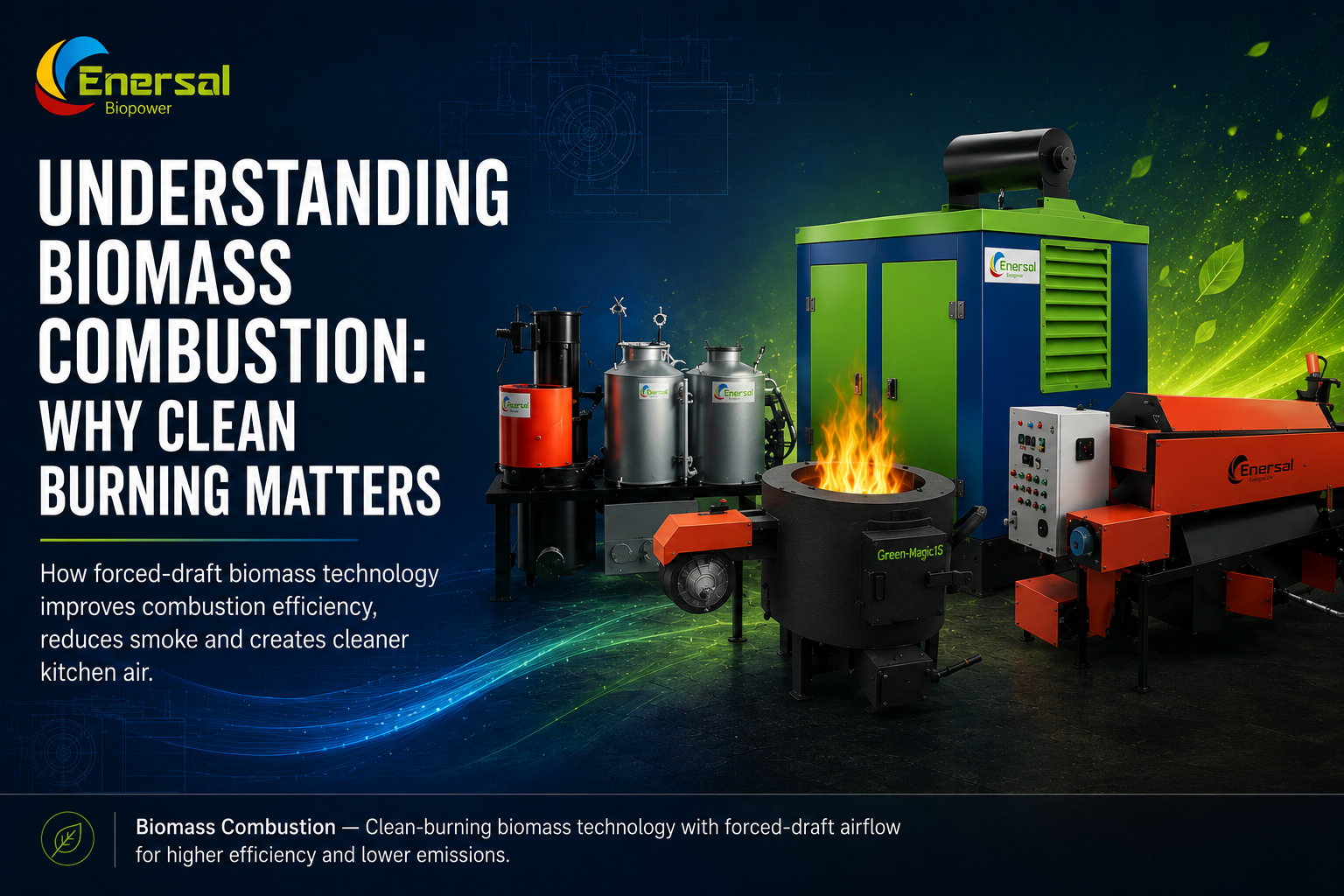
Every time you light a stove, a chemical reaction turns fuel into heat. How completely that reaction happens determines how much heat you actually get — and how much smoke fills your kitchen.
This is combustion efficiency: the percentage of fuel's energy that converts to useful heat, rather than being lost as unburned particles, carbon monoxide, water vapour, or smoke.
For most commercial kitchens using traditional biomass chulhas or poorly designed solid-fuel stoves, combustion efficiency sits between 12–18%. That means 80–88 paise of every rupee spent on biomass is wasted. Understanding why this happens — and how to fix it — can transform both your fuel cost and your kitchen environment.
What is Biomass Combustion?
Biomass combustion is the process of burning organic material — wood, agricultural waste, briquettes, or pellets — to produce heat. The chemical process is:
In a complete combustion reaction, almost all the carbon converts to CO₂, and all the hydrogen converts to water. You get the full calorific value of the fuel as heat.
In an incomplete combustion reaction, some carbon converts to CO (carbon monoxide) instead of CO₂, and some remains as soot. Far less heat is released and significant smoke is produced.
The key variable:
The difference between complete and incomplete combustion is almost entirely determined by the ratio of air to fuel in the combustion zone. Get this right, and you have clean, efficient burning. Get it wrong, and you have smoke, soot, and wasted fuel.
The Problem: Incomplete Combustion and What It Costs
Traditional biomass stoves have one fundamental problem: they cannot control airflow precisely.
Signs of incomplete combustion
- • Yellow or orange flame with visible smoke
- • Black soot on pots and walls
- • Strong burning smell after cooking
- • Fuel seems to "last less" than expected
- • Ash with unburned black particles
Energy losses
If you spend ₹10,000/month on biomass fuel with a traditional stove, ₹3,000–₹5,000 of that goes up as smoke rather than heating your food.
The Three Zones of a Biomass Flame
Zone 1 — Drying Zone (top of fuel bed)
Incoming biomass loses moisture. Wet fuel requires heat just to evaporate water before any combustion begins. Biomass above 20% moisture dramatically reduces useful heat output.
Zone 2 — Pyrolysis and Gasification Zone (middle)
Biomass breaks down under heat into combustible gases (hydrogen, methane, CO) and char. If insufficient air is present here, these gases pass through unburned — becoming smoke.
Zone 3 — Combustion Zone (above fuel bed)
Combustible gases mix with air and burn. The right air-to-gas ratio produces complete, efficient combustion. Too little air = smoke. Too much air = heat lost to excess airflow.
Controlling airflow at each zone separately is what separates a high-efficiency stove from a traditional one.
Why Traditional Stoves Burn Dirty
Traditional chulhas and open-grate stoves have no mechanism to control airflow. Air enters from wherever gaps exist — creating multiple failure modes:
Uneven air distribution
Some parts of the fuel bed get too much air, others too little — both producing incomplete combustion
Cold zones and quenching
Cold air flowing over the flame lowers temperature below ~800°C minimum required for complete combustion
Fuel loading gaps
Every time new fuel is added, a period of incomplete combustion begins again — fresh biomass releases volatile gases before the flame catches them
The result: even good-quality biomass briquettes deliver only 12–18% of their energy as useful heat in a traditional stove.
How Forced-Draft Technology Changes the Equation
A small electric fan (30–50W — less than a light bulb) forces a measured volume of air into the combustion chamber at controlled points:
Primary air
Delivered below the grate, through the fuel bed — creates a uniform gasification zone with consistent temperature and air-fuel mixing
Secondary air
Injected above the fuel bed at high velocity — ensures combustible gases produced in the gasification zone mix completely with oxygen and combust fully
| Parameter | Traditional Chulha | Enersol Forced-Draft |
|---|---|---|
| Flame temperature | 500–700°C | 900–1,100°C |
| Thermal efficiency | 12–18% | 35–40% |
| CO emissions | High | 80–90% lower |
| PM2.5 output | Very high | 60–75% lower |
| Fuel per meal | Baseline | 30–50% less |
Power cost note: The fan draws 30–50W. For a 12-hour cooking day, this adds approximately ₹2–₹4 to your electricity bill. The fuel savings from clean combustion are 100× larger.
Impact on Kitchen Air Quality
This dimension is consistently underestimated — and health authorities are increasingly focused on it.
Traditional open-flame kitchen — PM2.5 data
- PM2.5 levels during 8-hour cooking: 200–500 μg/m³
- Enclosed kitchens during peak hours: 600–800 μg/m³
- WHO safe daily average: 15 μg/m³
- Equivalent exposure for kitchen workers: smoking 20–40 cigarettes/day
With Enersol forced-draft stove
- PM2.5 output drops by 60–75%
- CO output drops by 80–90%
- Kitchen air stays consistently below 50–80 μg/m³
FSSAI and state food safety authorities increasingly inspect commercial kitchen air quality. Clean-burning stoves directly reduce compliance risk.
Combustion Efficiency and Your Fuel Bill
A dhaba burning biomass briquettes (4,000 kcal/kg) at ₹8/kg, cooking 10 hours a day:
| Stove Type | Efficiency | Fuel/Day | Cost/Day | Cost/Month |
|---|---|---|---|---|
| Traditional chulha | 14% | 12–15 kg | ₹96–₹120 | ₹2,880–₹3,600 |
| Enersol forced-draft | 38% | 5–6 kg | ₹40–₹48 | ₹1,200–₹1,440 |
Monthly saving from efficiency alone: ₹1,440–₹2,160
When a kitchen also switches from LPG to biomass, the combined saving reaches ₹40,000–₹60,000 per month for a busy operation.
Enersol's Clean-Burning Design
Enersol Biopower has been developing biomass stoves for commercial use in India for over 25 years. The current range incorporates five combustion-specific design features:
Cast-iron segmented grate
Allows precise primary airflow through the fuel bed. Ash falls clear continuously, preventing airflow blockage.
Secondary air injection ports
Positioned at the calculated height where volatile gases are densest — ensuring complete secondary combustion before exhaust exits.
Insulated combustion chamber
Refractory lining maintains chamber temperature above 850°C — the minimum for complete combustion of all volatile compounds.
Variable-speed air fan
Fan speed adjustable for different fuels (briquettes, pellets, wood chips) — maintains optimal air-fuel ratio across varying loads.
Stainless exhaust stack with spark arrestor
Captures remaining particulate before exhaust exits the stove — protecting kitchen workers directly adjacent to the unit.
Frequently Asked Questions
Does fuel type affect combustion quality?
Yes. Biomass briquettes with less than 15% moisture content produce the cleanest combustion. Wet wood or high-bark biomass produces more smoke. Enersol recommends briquettes made from agricultural waste for consistent performance.
How do I know if my stove has incomplete combustion?
Check the exhaust. If you see visible black smoke, smell strong carbon odour, or find heavy soot deposits on cookware, combustion is incomplete. A clean-burning flame is blue at the base and nearly invisible above.
Will switching to forced-draft reduce my flame control?
No. Modern Enersol stoves have variable fan speed control. Reducing fan speed reduces heat output — giving the same flame control as LPG burner adjustment.
How often does the combustion fan need replacement?
Enersol fans are rated for 10,000+ operating hours. At 12 hours/day, this is approximately 2.5 years. Replacement cost is ₹800–₹1,200.
Is clean-burning biomass better than LPG for the environment?
Biomass from agricultural waste is considered carbon-neutral — the CO₂ released was absorbed during crop growth. LPG releases net fossil carbon. With clean combustion, biomass is the better environmental choice.
Ready to Switch to Clean Combustion?
See how an Enersol forced-draft stove can cut your fuel consumption by 50% and make your kitchen environment healthier.
Get Free Consultation
About the Author
Rai Singh Dahiya
Founder & Chief Innovator, Enersol Biopower Pvt. Ltd.
Grassroots innovator and recipient of India's Fifth National Grassroots Innovation Award (2009). Selected as Innovation Scholar-in-Residence at Rashtrapati Bhavan (2015). Over 25 years of experience pioneering clean biomass energy solutions deployed at IITs, NITs, and in UNDP international projects across Africa and the Middle East.