
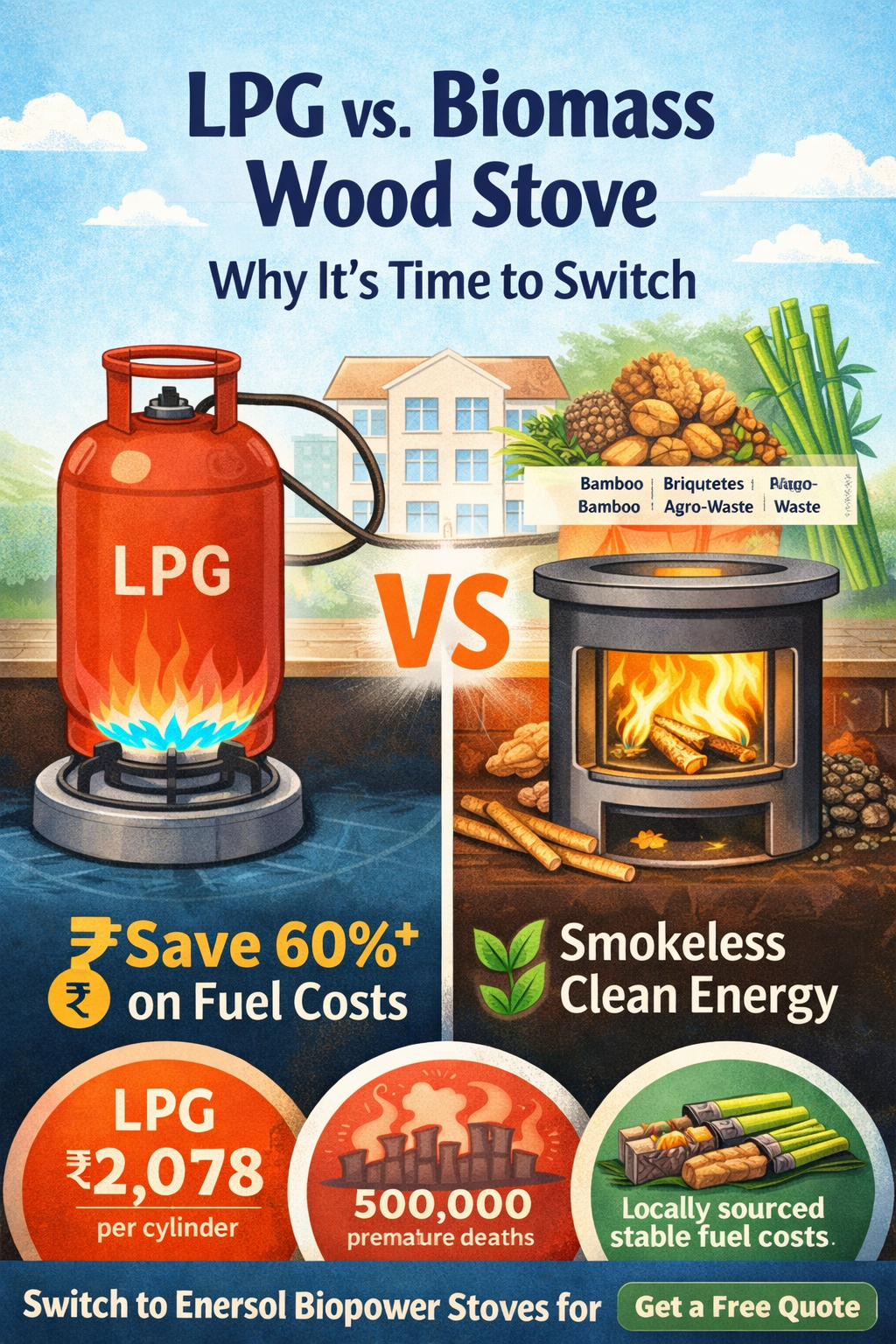
The LPG Price Crisis Hitting Indian Businesses
Imagine opening your monthly fuel bill to find it has jumped by Rs 195 overnight. That is exactly what happened to thousands of commercial kitchen operators across India in April 2026, when oil marketing companies raised the price of the 19 kg commercial LPG cylinder by Rs 195 to Rs 218 in a single revision — the second consecutive monthly hike. In Delhi, a 19 kg commercial cylinder now costs Rs 2,078; in Mumbai, Rs 2,031; in Kolkata, Rs 2,208.
This is not a one-off event. Commercial LPG in India is market-determined, meaning it directly tracks international crude oil and LPG benchmarks with no government subsidy shield. The April 2026 hike was driven by geopolitical tensions in West Asia disrupting global supply chains and pushing energy prices higher. India imports approximately 60% of its LPG requirement, making commercial users perpetually vulnerable to global price shocks they cannot predict or control.
For a confectionery business, restaurant, or commercial kitchen using 10 or more cylinders a month, this translates to an unplanned monthly cost increase of Rs 1,950 to Rs 2,180 — every time the global market moves. Over a year, price volatility like this can drain Rs 20,000 to Rs 50,000 from your bottom line without a single change in your operations.
There is an alternative — one that has been quietly transforming commercial kitchens across Rajasthan, UP, and Maharashtra since 2013. Enersol Biopower's smokeless biomass wood stoves offer comparable heat output at more than 60% lower fuel cost, sourced from locally available agricultural residues that are immune to international price volatility.
What Is a Biomass Wood Stove? (And How Does Enersol's Work?)
A biomass stove burns organic material — wood, bamboo, coconut shells, crop residue, or compressed briquettes — as fuel instead of fossil-derived LPG. What makes Enersol Biopower's stoves different from a traditional mud chulha is the engineering behind the combustion.
Enersol's range uses two key combustion principles:
- Forced-draft combustion: An AC blower (typically 165W) supplies controlled air to the combustion chamber, ensuring more complete burning of fuel gases. This is what produces the stove's near-smokeless flame and higher thermal efficiency.
- Natural-draft combustion: Used in domestic and smaller models, this design relies on carefully engineered air inlets and grate positioning to achieve clean combustion without electricity.
The result is a stove that delivers heat comparable to LPG — tested and validated for confectionery production, food processing, institutional cooking, and commercial kitchens — while consuming locally sourced biomass fuel that costs a fraction of gas.
About Enersol Biopower: Founded in Jaipur, Rajasthan in 2013 by Mr. Rai Singh Dahiya, a grassroots innovator who observed firsthand how indoor cooking smoke and expensive diesel generators were destroying the health and livelihoods of rural communities. His company introduced India's first portable biomass gasifier, earned the National Grassroots Innovation Award, and was recognised at Rashtrapati Bhavan in 2016. The company is ISO 9001:2015 certified with a dedicated quality control process.
Cost Savings: The Hard Numbers
Let us run the actual numbers for a commercial kitchen or sweet shop currently using LPG.
With LPG (Monthly)
- LPG price (Delhi, Apr 2026): Rs 2,078 / 19 kg cylinder
- Usage (medium sweet shop): 8–12 cylinders/month
- Monthly spend: Rs 16,624 – Rs 24,936
With Biomass Stove (Monthly)
- Biomass fuel cost: ~60% lower per unit of energy
- Monthly spend: Rs 6,650 – Rs 9,974
- Monthly savings: Rs 9,974 – Rs 14,962
Annual savings: Rs 1.2 lakh to Rs 1.8 lakh
For high-volume operations like the Jumbo Shakti36 stove customers, Enersol reports savings of over Rs 25,000 per month and full ROI in as little as two months. For the Green-Magic15 commercial stove used in confectionery, savings per cylinder replaced range from Rs 841 to Rs 1,173.
Beyond the monthly fuel bill, businesses gain a second layer of financial protection: biomass fuel prices do not move with international oil markets. Whether crude is at $60 or $100 a barrel, the cost of bamboo chips or agricultural briquettes from a local supplier remains largely stable. This budget predictability is itself a significant business advantage.
LPG vs. Biomass: A Complete Comparison
The table below summarises the key differences between running your commercial kitchen on LPG versus switching to an Enersol Biopower biomass stove:
| Factor | LPG Stove | Enersol Biomass Stove | Your Gain |
|---|---|---|---|
| Monthly cost (10 cylinders) | ~₹20,780 | ~₹8,312 | ₹12,468 saved |
| Price volatility | High — global market linked | Low — local sourcing | Predictable budget |
| Smoke emissions | High if burner inefficient | Near-zero (smokeless) | Healthier kitchen |
| ROI on equipment | No capital cost savings | 2–5 months | Fast payback |
| Fuel source dependence | 60% imported | Local agro-waste | Energy independence |
| CO2 impact | Fossil fuel emissions | Carbon neutral | Eco-friendly |
Note: LPG cost calculations are based on the April 2026 Delhi commercial cylinder price of Rs 2,078 per 19 kg cylinder. Biomass cost estimates are based on locally sourced briquettes and wood chips.
Health Benefits of Switching to a Smokeless Stove
The financial case for switching is compelling. But for the women and kitchen workers who spend hours each day in front of a stove, the health case is even more urgent.
According to data from the Clean Cooking Alliance and multiple Indian public health studies, indoor air pollution from traditional biomass burning is responsible for over 500,000 premature deaths in India annually. Women who cook in poorly ventilated kitchens face significantly elevated risk of:
- Chronic obstructive pulmonary disease (COPD)
- Pneumonia and acute respiratory infections
- Cardiovascular disease linked to particulate matter exposure
- Eye irritation and long-term vision damage from sustained smoke exposure
With Enersol Smokeless Stoves:
- Near-complete combustion reduces PM2.5 emissions by 50–80%
- Controlled air-fuel ratio eliminates visible smoke
- Lower absenteeism and higher kitchen productivity
- Reduced employer liability in commercial kitchens
Traditional chulhas and open flame setups have thermal efficiency as low as 17%, meaning most of the fuel is lost as smoke rather than converted to useful heat. That smoke contains carbon monoxide, black carbon, and fine particulate matter (PM2.5) — all classified as serious health hazards.
Enersol's forced-draft biomass stoves are specifically engineered to eliminate this problem. Independent research from SINTEF Energy Research has shown that improved combustion design can reduce particle emissions by 50 to 80% compared to traditional stoves. For business owners, healthier kitchen workers mean lower absenteeism, reduced liability, and a more productive team.
Environmental Impact: Why Biomass Is Carbon-Neutral
One of the most common questions about biomass stoves is whether burning wood or agricultural waste is actually better for the environment than gas. The answer, when done correctly with quality stoves and sustainably sourced fuel, is yes.
The key principle is the carbon cycle. The CO2 released when biomass burns is the same CO2 that was absorbed by the plant during its growing cycle. Unlike burning fossil fuels — which releases carbon that has been locked underground for millions of years — burning biomass is part of a naturally closed loop. This is why biomass is classified as carbon-neutral energy under international climate frameworks.
Enersol's stoves use agricultural residues such as bamboo, coconut shells, crop stalks, and wood chips — materials that would otherwise be burned in open fields. By converting this waste into useful cooking energy, Enersol's stoves:
- Reduce open-field stubble burning, a major contributor to North India's seasonal air quality crisis
- Lower India's dependence on imported fossil fuels, supporting energy security
- Reduce deforestation pressure by making agricultural waste a viable fuel alternative to firewood
- Minimise greenhouse gas emissions compared to inefficient traditional cooking methods
India has committed to significant renewable energy and emissions reduction targets. Choosing a biomass stove over LPG is a direct, practical way for any business to align with these national sustainability goals.
Best Biomass Fuels for Your Stove
Not all biomass fuels are equal. The right fuel depends on your stove model, your cooking load, and local availability. Here is a quick reference guide:
| Fuel Type | Heat Output | Cost | Best For |
|---|---|---|---|
| Bamboo / wood chips | Very High | Very Low | Any Enersol model |
| Biomass briquettes | High | Low | All models |
| Coconut shells | High | Very Low | Commercial bhattis |
| Agricultural residue | Medium-High | Near Zero | Institutional models |
| Wood pellets | High | Low-Medium | All models |
Pro tip from Enersol's field teams: Always ensure your biomass fuel has less than 20% moisture content. Wet fuel reduces combustion efficiency, increases smoke, and can damage the combustion chamber over time. Store fuel in a dry, covered area and source from a consistent supplier to maintain stove performance.
Which Businesses Benefit Most?
Enersol Biopower's stove range covers a wide spectrum of commercial and institutional applications. The businesses that see the fastest ROI and biggest cost impact are:
Sweet Shops & Halwais
High daily heat usage with LPG makes the cost differential most visible. Businesses like Goyal Misthan Bhandar, Beawar have already made the switch.
Restaurants & Dhabas
Extended cooking hours mean sustained fuel consumption — biomass savings compound quickly over a month.
Bakeries & Confectionery Units
Consistent high-heat requirements are well-matched to forced-draft biomass stoves.
Schools, Hostels & Ashrams
Institutional kitchens cooking for 100+ people daily benefit enormously from bulk biomass fuel savings and lower per-meal cost.
Catering & Event Kitchens
Portable and commercial models are suited for high-volume, time-bound cooking.
Agro-Processing Units
Biomass fuel from the same agricultural supply chain as raw materials creates a closed-loop cost advantage.
Frequently Asked Questions
Q1: Does a biomass stove deliver the same heat as LPG?
Yes. Enersol Biopower's commercial biomass stoves are specifically engineered to deliver heat output comparable to LPG stoves. The Bio-Akash21 and Bio-Prithvi24 models, for example, are designed for confectionery and food processing applications where consistent, high heat is non-negotiable. Thousands of commercial kitchens across India have validated this in real-world use.
Q2: Where do I get biomass fuel, and how much does it cost?
Biomass fuel — including bamboo, wood chips, coconut shells, and agro-briquettes — is widely available across India from local agricultural suppliers, biomass briquette manufacturers, and agro-processing units. It is typically 60 to 70% cheaper per unit of energy than commercial LPG. Enersol's team helps new customers identify local fuel sources and set up a reliable supply strategy during installation.
Q3: Is a biomass stove difficult to operate or maintain?
No. Enersol's stoves are designed for straightforward daily operation — manual fuel feeding, simple flame adjustment via blower speed or air inlets, and easy ash removal. Maintenance requirements are low. The robust mild steel and ceramic brick construction is built for long service life. Enersol provides hands-on training for kitchen staff as part of every installation.
Q4: What is the payback period on the investment?
It varies by model and usage volume, but most commercial customers see full return on their stove investment within 2 to 5 months. After that, 100% of the monthly savings go directly to profit. A business spending Rs 20,000/month on LPG can recover the cost of a mid-range Enersol commercial stove within two to three months of switching.
Q5: Is it safe to use inside a commercial kitchen?
Yes, when installed and operated correctly. Enersol's smokeless combustion design means minimal indoor smoke, making it significantly safer than traditional open-fire methods. The company recommends adequate kitchen ventilation (as with any cooking equipment) and provides detailed safety guidelines. All stoves are tested for quality compliance under Enersol's ISO 9001:2015 certified production process.
Q6: Can I use any kind of wood or biomass as fuel?
Enersol recommends clean, dry biomass with no foreign matter such as dust, dirt, stones, metal, plastic, glass, or oil contamination. Suitable fuels include bamboo, wood chips, juliflora, coconut shells, dry cow dung cakes, and clean crop residues. Wet or contaminated fuel reduces efficiency and can damage the combustion chamber over time.
Q7: Does switching to biomass align with government sustainability goals?
Absolutely. Biomass energy is recognised as a renewable, carbon-neutral fuel under India's national energy policy. It supports the Atmanirbhar Bharat vision by reducing dependence on imported fossil fuels and creating local fuel economy. Several government schemes for rural electrification and clean cooking also support biomass-based solutions.
Final Verdict: Is the Switch Worth It?
The answer, for the vast majority of commercial kitchens, sweet shops, restaurants, and institutional cooking operations in India, is an unequivocal yes.
The business case is solid: 60%+ monthly fuel savings, an ROI period measured in months rather than years, and freedom from the price volatility that has added Rs 195 to Rs 218 to commercial LPG cylinder costs in a single month. The health case is equally compelling: smokeless combustion protects kitchen workers from one of India's leading occupational health hazards. And the environmental case aligns your business with India's clean energy future.
Enersol Biopower has been building and refining these stoves since 2013. With National Grassroots Innovation recognition, ISO 9001:2015 certification, and thousands of satisfied customers from sweet shops in Rajasthan to institutional kitchens across the country, the brand carries the trust that a major operational decision demands.
The question is not whether you can afford to switch.
The question is whether you can afford not to.
About Enersol Biopower
Enersol Biopower Pvt. Ltd. is a Jaipur-based manufacturer, supplier, and exporter of biomass gasifiers, smokeless biomass stoves, and biogas generator sets. Founded in 2013 by Grassroots Innovator Mr. Rai Singh Dahiya, the company introduced India's first portable biomass gasifier and has earned national recognition for its contributions to clean, affordable rural energy. Enersol is ISO 9001:2015 certified.
Ready to Cut Your Fuel Costs by 60%?
Get a free consultation from Enersol Biopower. Share your kitchen size, current LPG usage, and cooking needs — we'll recommend the right biomass stove model and help you calculate your monthly savings.
Get a Free Quote
About the Author
Rai Singh Dahiya
Founder & Chief Innovator, Enersol Biopower Pvt. Ltd.
Grassroots innovator and recipient of India's Fifth National Grassroots Innovation Award (2009). Selected as Innovation Scholar-in-Residence at Rashtrapati Bhavan (2015). Over 25 years of experience pioneering clean biomass energy solutions deployed at IITs, NITs, and in UNDP international projects across Africa and the Middle East.