

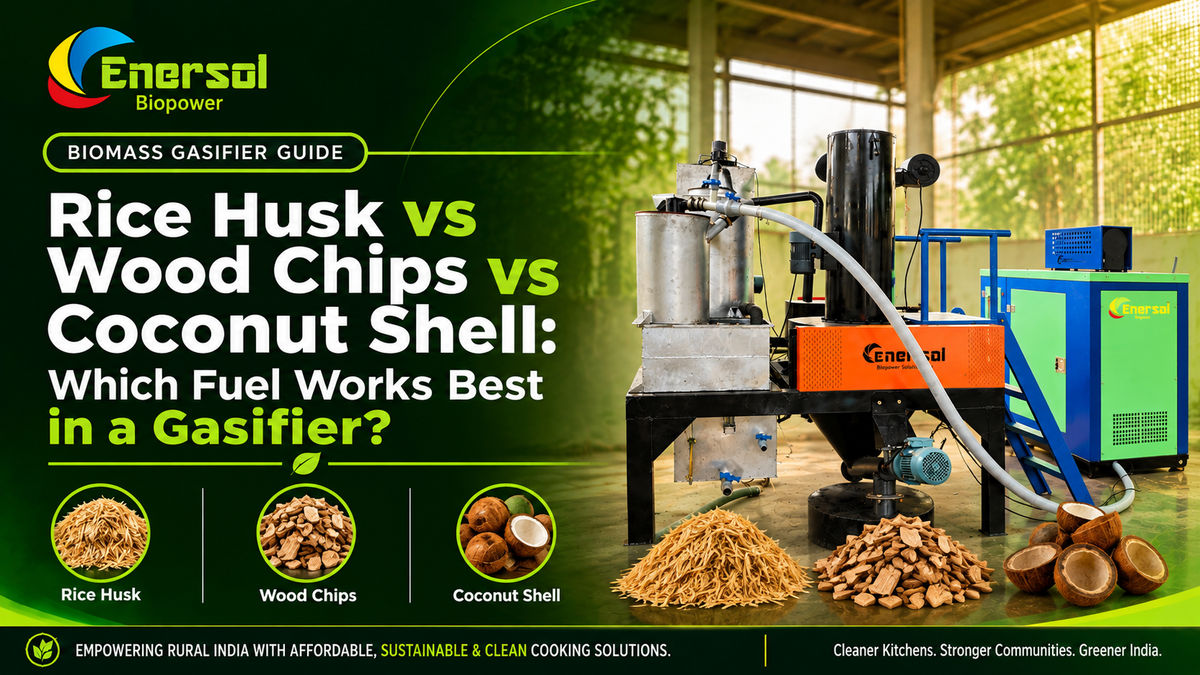
Rice Husk vs Wood Chips vs Coconut Shell: Which Fuel Works Best in a Gasifier?
Wood chips and coconut shell are the easiest fuels to gasify because they are dense and low in ash. Rice husk works well too, but only in a gasifier designed for it. The best fuel for you is the one you can get dry, all year, for a gasifier built to use it.
By Rai Singh Dahiya, Founder, Enersol Biopower | Published 09 November 2026
The Short Answer
- Wood chips: Easy to gasify and widely used, if they are dry and evenly sized.
- Coconut shell: Dense and low in ash, a very good fuel where it is available.
- Rice husk: Plentiful near rice mills, but high in ash and needs a husk-ready gasifier.
- For all three: Keep moisture below 20%.
- Rule of thumb: Choose the fuel first, then the gasifier designed for it.
Why Fuel Choice Matters So Much
A gasifier is not a furnace that burns whatever you feed it. It heats biomass with a limited supply of air so the fuel turns into producer gas. How well that works depends on how the fuel moves through the reactor, how much ash it leaves behind and how much water it carries in.
That is why the same gasifier can run smoothly on one fuel and struggle on another. Rice husk, wood chips and coconut shell are three of the most common choices in India, and each behaves very differently.
Side-by-Side Comparison
Here is how the three fuels usually compare. Exact values vary with the source, season and how the fuel is stored, so test your own fuel before you design a plant around it.
| Feature | Rice Husk | Wood Chips | Coconut Shell |
|---|---|---|---|
| Ash content | High | Low | Low |
| Density | Very light | Medium | High |
| Preparation needed | Little, or briquetting | Chipping, sizing and drying | Breaking into pieces |
| Ease of gasification | Needs a husk-ready design | Easy if evenly sized | Easy |
| Ash handling | Heavy, frequent removal | Light | Light |
| Storage space per tonne | Large | Medium | Small |
| Where it is plentiful | Rice-growing regions, near mills | Near plantations, sawmills and forests | Coastal and southern India |
| Best suited to | Rice mills and nearby units | Most general power and heat uses | Sites with a steady shell supply |
Rice Husk: Plentiful but Ash-Heavy
Rice husk is the shell left after paddy is milled. In rice-growing areas it piles up at every mill, which makes it one of the most available biomass fuels in India.
What works: It is already small and fairly dry when it leaves the mill, so it needs little preparation. For a rice mill, using its own husk to make power closes the loop neatly. Our blog on turning rice mill waste into electricity covers this in detail.
What to watch:
- High ash: Husk leaves far more ash than wood, so the gasifier must remove ash steadily or the reactor clogs.
- Very light: Loose husk takes a lot of space to store and can flow unevenly through a reactor built for chunky fuel.
- Design matters: Use a gasifier designed for husk, not one designed for wood chips.
Tip: Briquetting or pelleting husk makes it denser, cleaner to handle and easier to feed.
Wood Chips: The All-Rounder
Wood chips come from plantation wood, prunings, sawmill waste and forestry residue. They are the fuel many gasifiers are designed around. Enersol's 10 kW ESB-R10, for example, is listed as working with wood chips, along with pellets, briquettes, agro-waste and forestry waste.
What works: Clean wood is low in ash and gasifies readily, so the gas stays steady and the reactor stays clean.
What to watch:
- Sizing: Chips should be fairly uniform. Dust and very fine pieces can block the reactor, and oversized pieces can bridge and let air channel through.
- Moisture: Freshly cut wood is wet. Chips usually need drying to bring moisture below 20%.
- Bark and dirt: Bark, soil and stones add ash and can cause clinkers, so keep the fuel clean.
Coconut Shell: Dense and Clean-Burning
Coconut shell is the hard inner shell left after the coconut is used. It is plentiful in coastal and southern India, where coconut processing is a large industry.
What works: Shell is dense, hard and low in ash. Once it is broken into suitably sized pieces it flows well through the reactor, stores compactly and produces a steady gas.
What to watch:
- Breaking it down: Whole shells are too large and too hard for most reactors, so they need crushing to size.
- Regional supply: Outside coconut-growing regions, transport can make it impractical.
- Competition: Coconut shell is also used to make charcoal and activated carbon, so supply and demand can shift.
The Rule That Applies to Every Fuel: Keep It Dry
Whichever fuel you choose, moisture is the biggest enemy. Water takes heat away from the reaction, which weakens the gas and adds to tar. Keep fuel moisture below 20%.
- Store fuel under a roof and off the ground.
- Keep enough dry stock to get through the monsoon.
- Use the oldest, driest fuel first.
- Check moisture when a new batch arrives, especially from a new supplier.
How to Choose the Right Fuel for Your Site
Instead of asking which fuel is best in general, ask these questions about your own site:
- What is available within easy reach, all year round, not just after harvest?
- Can you keep it dry and store enough of it?
- Do you already produce it, like a rice mill with husk or a coconut unit with shell?
- Who will handle the ash, and how often?
- Will the supply stay steady if other buyers start competing for it?
Then choose a gasifier designed for that fuel. A good manufacturer will ask to test a sample of your fuel before recommending a model. That is one of the 10 questions to ask any gasifier manufacturer.
Frequently Asked Questions
Which is the best fuel for a biomass gasifier?
There is no single best fuel. Wood chips and coconut shell are the easiest to gasify because they are dense and low in ash. Rice husk works well in gasifiers designed for it and is often cheap where rice mills are close by. The best fuel is the one you can get dry, in a steady supply, for a gasifier designed to burn it.
Can rice husk be used in a biomass gasifier?
Yes. Rice husk is a common gasifier fuel in rice-growing regions. It is light and high in ash, so the gasifier needs to be designed for husk, with good ash removal. Briquetting or pelleting the husk makes it denser and easier to handle.
Is coconut shell good for gasification?
Yes. Coconut shell is dense, hard and low in ash, which makes it a good gasifier fuel once it is broken into suitably sized pieces. Its main limits are regional supply and competition from charcoal makers.
What size should wood chips be for a gasifier?
Wood chips should be fairly uniform and within the size range your gasifier is designed for. Very fine pieces and dust can block the reactor, while oversized pieces can bridge and let air channel through. Check the recommended size in your gasifier's manual.
How dry should gasifier fuel be?
Gasifier fuel should be dry, with moisture usually kept below 20%. Wet fuel weakens the producer gas and increases tar, whichever fuel you use.
Can you mix different fuels in one gasifier?
Sometimes, but only within the limits of the gasifier's design. Fuels with very different size, density or ash content can flow and react unevenly. Ask your supplier before mixing fuels, and change the mix gradually.
Not Sure Which Fuel Suits You?
Tell us what biomass you have and how much. We will tell you whether it suits a gasifier and which design fits it.
Check Your Fuel →
Recipient of India's Fifth National Grassroots Innovation Award (2009), invited as Innovation Scholar-in-Residence at Rashtrapati Bhavan (2015). Over 25 years of experience designing biomass energy technology for rural India.