

Which Enersol Stove Is Right for You? A Model Guide from Homes to Institutions
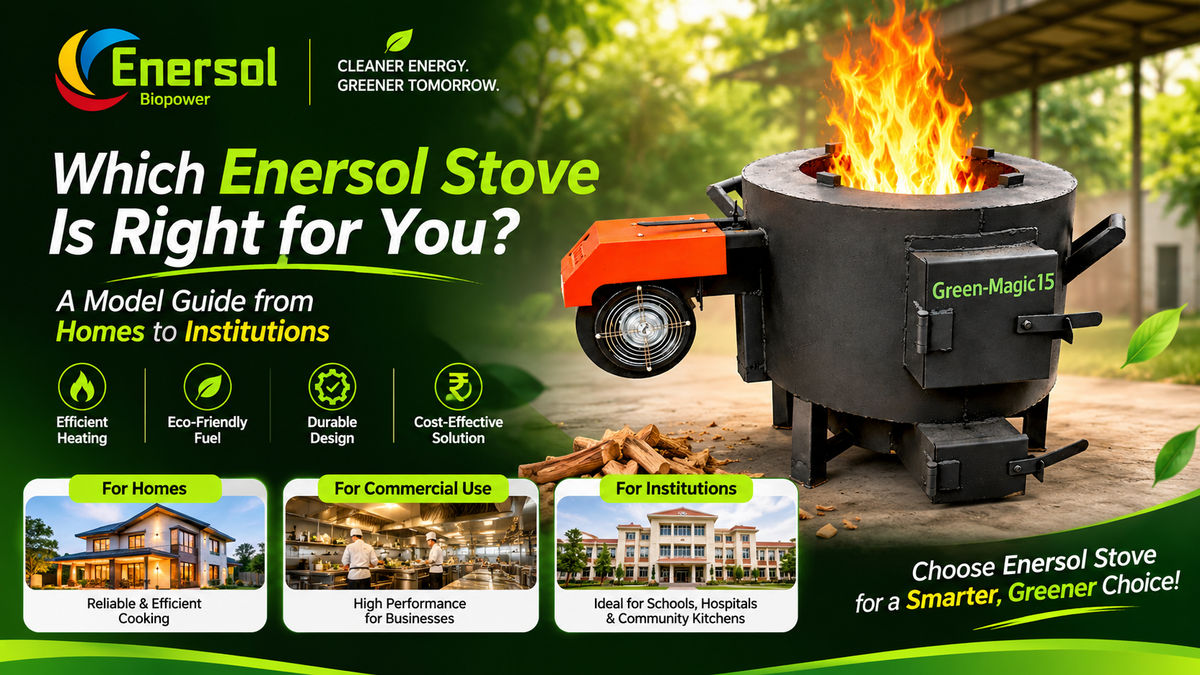
The right Enersol stove depends on how many people you cook for, your largest vessel, your fuel, your power supply and your kitchen space. Home and small-stall users usually start with the Bio-Mini range, food businesses with Green-Agnika or Harit Agni, and bulk kitchens with the larger Bio and Jumbo models.
By Rai Singh Dahiya, Founder, Enersol Biopower | Published 09 October 2026
Key Article Highlights
- Enersol's range runs from 14 kg home stoves to a 650 kg bulk cooking stove
- Match the stove's fire zone to your largest vessel
- A bigger stove burns more fuel, so do not buy more than you need
- Check your floor and access before you order a large stove
- Listed models need fuel below 20% moisture
Start with 5 Simple Questions
Before you look at any model, answer these. They will narrow the choice quickly.
The Enersol Stove Range at a Glance
This table lists the main figures for each model, from Enersol's product data.
| Model | Biomass Use | Power | Weight | Best Fit |
|---|---|---|---|---|
| Bio-Nature | Not listed | Natural draft | Not listed | Homes, 5–25 people |
| Bio-Mini | 1.5–2 kg/hr | 12V DC fan | 14 kg | Homes, tea stalls |
| Bio-Mini Solar | 1.5–2 kg/hr | 12V DC fan, 10W panel | 14 kg | Low-power areas |
| Green-Agnika10 | 5–10 kg/hr | 4" AC fan | 40–50 kg | Stalls, small mess, up to 50 people |
| Harit Agni 12 | 5–10 kg/hr | 4" AC fan | 70 kg | Dhabas, 50–60 people a session |
| Green-Magic15 | 12–25 kg/hr | 100W blower | 190–200 kg | Sweet shops, hotels |
| Bio-Virat18 | 16–30 kg/hr | 165W blower | 220 kg | Commercial kitchens |
| Bio-Akash21 | 20–35 kg/hr | 165W blower | 250–260 kg | Sweets, namkeen, hotels |
| Bio-Prithvi24 | 25–30 kg/hr | 200W blowers | 320 kg | Food processing, community cooking |
| Harit-Jumbo27 | 35–80 kg/hr | 2 × 165W blowers | 400 kg | Large-scale food businesses |
| Jumbo-Shakti36 | 70–150 kg/hr | 415W blowers | 650 kg | Bulk cooking, religious institutions |
Which Stove for Which Kitchen?
Homes and Small Families
Look at the Bio-Nature, Bio-Mini and Bio-Mini Solar. The Bio-Nature is a natural-draft stove. The Bio-Mini adds a fan and flame regulator. If you face frequent power cuts or use kerosene lamps, see our guide to solar biomass stoves.
Tea Stalls, Street Food and Small Dhabas
Very small stalls can start with a Bio-Mini. If you cook all day or fry in batches, step up to the Green-Agnika10 or Harit Agni. The Green-Agnika10 is listed for mess and canteen meals for up to 50 people. Our Harit Agni article covers that model in more detail.
Sweet Shops and Namkeen Makers
These kitchens need strong, even heat under wide kadhais. Compare the Green-Magic15 (15-inch), Bio-Virat18 (18-inch) and Bio-Akash21 (21-inch). Match the size to your largest kadhai and your daily output.
Schools, Hostels and Institutions
Do not choose by total headcount alone. Think about how many dishes cook at the same time. Several mid-size stoves can be more flexible than one large stove, and they give you backup too. Use our purchase checklist for institutions.
Bulk Cooking and Food Processing
The Bio-Prithvi24 (24-inch), Harit-Jumbo27 (27-inch) and Jumbo-Shakti36 (36-inch) are built for high-volume work. They are large installations, so plan the site, chimney and fuel handling before you order.
Bigger Is Not Always Better
It is tempting to buy the largest stove you can afford. But a stove that is too big for your vessel wastes heat, and it burns more fuel than you need. A stove that is too small slows your kitchen down at the busiest time.
- Vessel fit: Check how your largest vessel sits on the stove.
- Peak load: Size for the busiest session, and allow a little room for growth.
- Fuel check: Multiply the fuel use by your cooking hours. A stove using 12–25 kg an hour for 4 hours needs about 48–100 kg a day.
- Backup: In a kitchen that cannot stop, two smaller stoves can be safer than one large one.
Check Your Site Before You Order
Larger stoves are serious pieces of equipment. Harit-Jumbo27 weighs about 400 kg, and Jumbo-Shakti36 about 650 kg, before you add a full vessel.
- Floor: Can it carry the stove and a full vessel?
- Access: Will the stove pass through your doors and passages?
- Chimney: Where will the exhaust go?
- Fuel: Where will you store the fuel, and who will carry it?
- Power: Do you have a stable supply and backup for the blowers?
Frequently Asked Questions
Which Enersol stove is best for a home?
The Bio-Nature, Bio-Mini and Bio-Mini Solar are the home-sized models, all listed for 5–25 people. Choose the Bio-Mini for a forced-draft stove, and the Bio-Mini Solar if you also want a solar panel and an LED light.
Which stove suits a tea stall or small dhaba?
The Bio-Mini suits very small stalls. The Green-Agnika10 is listed for tea stalls, snack vendors and small hotels, and for mess and canteen meals for up to 50 people. Harit Agni is another option for slightly larger batches.
Which stove is best for a sweet shop?
Sweet shops often need a large fire zone for wide kadhais. The Green-Magic15, Bio-Virat18 and Bio-Akash21 are listed for sweet shops. Larger producers can look at the Harit-Jumbo27. Match the fire zone to your largest kadhai.
Which stove is right for a large institution?
It depends on meals per session, vessel sizes and how many dishes cook at once. Several mid-size stoves can be more flexible than one large stove, and they also give you backup. Ask for a recommendation based on your menu.
Do all Enersol stoves need electricity?
Forced-draft models need power for a fan or blower, from a 12V DC fan on the Bio-Mini to 415W of blowers on the Jumbo-Shakti36. The Bio-Nature is a natural-draft stove. Plan backup power if your area has frequent cuts.
What fuel do Enersol stoves use?
They run on 100% biomass, such as briquettes, pellets, wood chips or dry agricultural residue. Fuel moisture should be below 20%. Check the best fuel size for your model before you buy.
Still Not Sure Which Stove Fits?
Tell us how many people you cook for, your largest vessel and your fuel. Our team will recommend the right model.
Get a Free Quote →
Recipient of India's Fifth National Grassroots Innovation Award (2009), invited as Innovation Scholar-in-Residence at Rashtrapati Bhavan (2015). Over 25 years of experience designing biomass energy technology for rural India.