

Biomass Gasification vs Combustion: What Is the Difference?
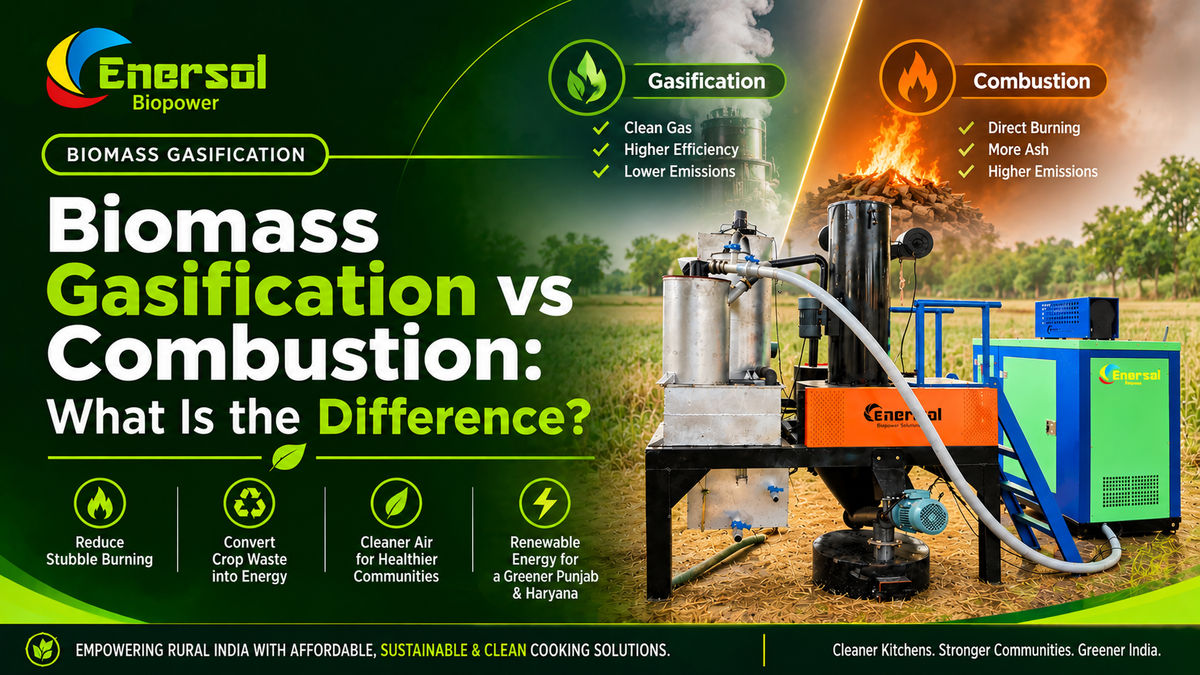
Combustion burns biomass completely with plenty of air and gives you heat straight away. Gasification uses only limited air, so the biomass turns into a combustible producer gas that can be cleaned and burned later, in an engine for electricity or a burner for heat.
By Rai Singh Dahiya, Founder, Enersol Biopower | Published 15 November 2026
The Difference in Brief
- Air: Combustion uses plenty of air; gasification uses a limited supply.
- Output: Combustion gives heat; gasification gives a fuel gas.
- Electricity: Producer gas can run an engine; open burning cannot.
- Control: Gas can be cleaned, piped and burned exactly where it is needed.
- Simplicity: Combustion is simpler when all you need is direct heat.
What Combustion Is
Combustion is ordinary burning. Biomass meets enough air for all its fuel to react, and it releases heat, carbon dioxide, water vapour and ash. A chulha, a furnace and most boilers work this way.
The heat appears right where the fuel burns. That is fine for cooking or raising steam, but it means the energy has to be used on the spot. You cannot pipe a flame to an engine. How cleanly the fuel burns also matters a great deal, as our blog on why clean burning matters explains.
What Gasification Is
Gasification deliberately holds back the air. Biomass is heated with only a limited supply of air, so instead of burning away completely it breaks down into a combustible producer gas. Enersol describes the process as taking place at about 700 to 900°C.
Producer gas is mainly carbon monoxide, hydrogen and methane, mixed with nitrogen and carbon dioxide. Enersol lists its energy value at about 1,000 to 1,200 kcal per normal cubic metre. Because it is a gas, it can be cooled, cleaned and sent to an engine, a burner or a dryer.
Side-by-Side Comparison
| Feature | Combustion | Gasification |
|---|---|---|
| Air supply | Plenty, enough to burn the fuel fully | Limited, on purpose |
| Main output | Heat | Producer gas (a fuel) |
| Other outputs | Carbon dioxide, water vapour, ash | Ash and some char |
| Where energy is used | Right where the fuel burns | Wherever the gas is piped |
| Can run an engine? | No, not directly | Yes, after gas cleaning |
| Flame control | Depends on how the fuel is fed | Gas flow can be controlled like LPG |
| Fuel needs | More forgiving | Dry, suitably sized fuel |
| Typical equipment | Stoves, furnaces, boilers | Gasifier with gas cleaning, engine or burner |
What Happens Inside a Gasifier
A gasifier is not the opposite of burning. It contains a small, controlled burning zone that supplies the heat for everything else. As fuel moves through the reactor, it passes through four stages:
- Drying: Heat drives water out of the fuel.
- Pyrolysis: The dry fuel breaks down into vapours, gases and char.
- Oxidation: The limited air burns part of the fuel, producing the heat the process needs.
- Reduction: Hot char reacts with carbon dioxide and water vapour to form carbon monoxide and hydrogen, the fuel part of producer gas.
This is also why wet fuel causes trouble. Every bit of water has to be boiled off in the drying stage, taking heat away from the reactions that make the gas. Keep fuel moisture below 20%.
Where Pyrolysis Fits
A third process is often confused with these two. The easiest way to tell them apart is by the oxygen they use:
| Process | Oxygen | Main product |
|---|---|---|
| Combustion | Plenty | Heat |
| Gasification | Limited | Producer gas |
| Pyrolysis | None | Biochar, bio-oil and gas |
Enersol describes pyrolysis as taking place at about 400 to 700°C. Our guide to biomass vs biogas vs pyrolysis compares these technologies for agro-industries.
When to Choose Each
Choose combustion when all you need is heat in one place and you want the simplest equipment. Cooking, small furnaces and many boilers fall into this group. For cooking, a smokeless biomass stove is a good example of well-controlled combustion.
Choose gasification when:
- You want electricity, because only a gas or liquid fuel can run an engine.
- You want a clean, steady flame you can control, like LPG, for drying or process heat. See our guide to gasifiers for process heat.
- You want to replace diesel, LPG or furnace oil with biomass in equipment built around a gas flame.
A Common Mix-Up
Because a gasifier has a burning zone inside it, people often think of it as just another furnace. The difference is in what comes out. A furnace gives you heat that must be used immediately. A gasifier gives you a fuel you can clean, carry through a pipe and burn when and where you choose. For more mix-ups like this, read Myth vs Fact: What People Get Wrong About Biomass Gasifiers.
Frequently Asked Questions
What is the difference between biomass gasification and combustion?
Combustion burns biomass completely with plenty of air and gives heat directly. Gasification heats biomass with a limited supply of air, so it turns into a combustible producer gas that can be cleaned and burned later in an engine or burner.
Is gasification better than combustion?
It depends on what you need. Gasification is the better choice when you want electricity from an engine or a clean, controllable gas flame. Combustion is simpler and suits jobs that only need direct heat, such as many boilers and stoves.
What does biomass gasification produce?
It produces producer gas, mainly carbon monoxide, hydrogen and methane with nitrogen and carbon dioxide, along with ash and some char. Enersol lists the gas energy value at about 1,000 to 1,200 kcal per normal cubic metre.
At what temperature does biomass gasification happen?
Enersol describes biomass gasification as taking place at about 700 to 900°C, with a limited supply of air.
How is pyrolysis different from gasification and combustion?
Combustion uses plenty of air, gasification uses limited air, and pyrolysis uses no oxygen at all. Pyrolysis, at about 400 to 700°C, produces biochar, bio-oil and gas rather than a fuel gas or direct heat.
Gasifier or Furnace? Ask Us
Tell us whether you need power, heat or both. We will tell you which approach fits your fuel and your site.
Talk to Our Team →
Recipient of India's Fifth National Grassroots Innovation Award (2009), invited as Innovation Scholar-in-Residence at Rashtrapati Bhavan (2015). Over 25 years of experience designing biomass energy technology for rural India.