

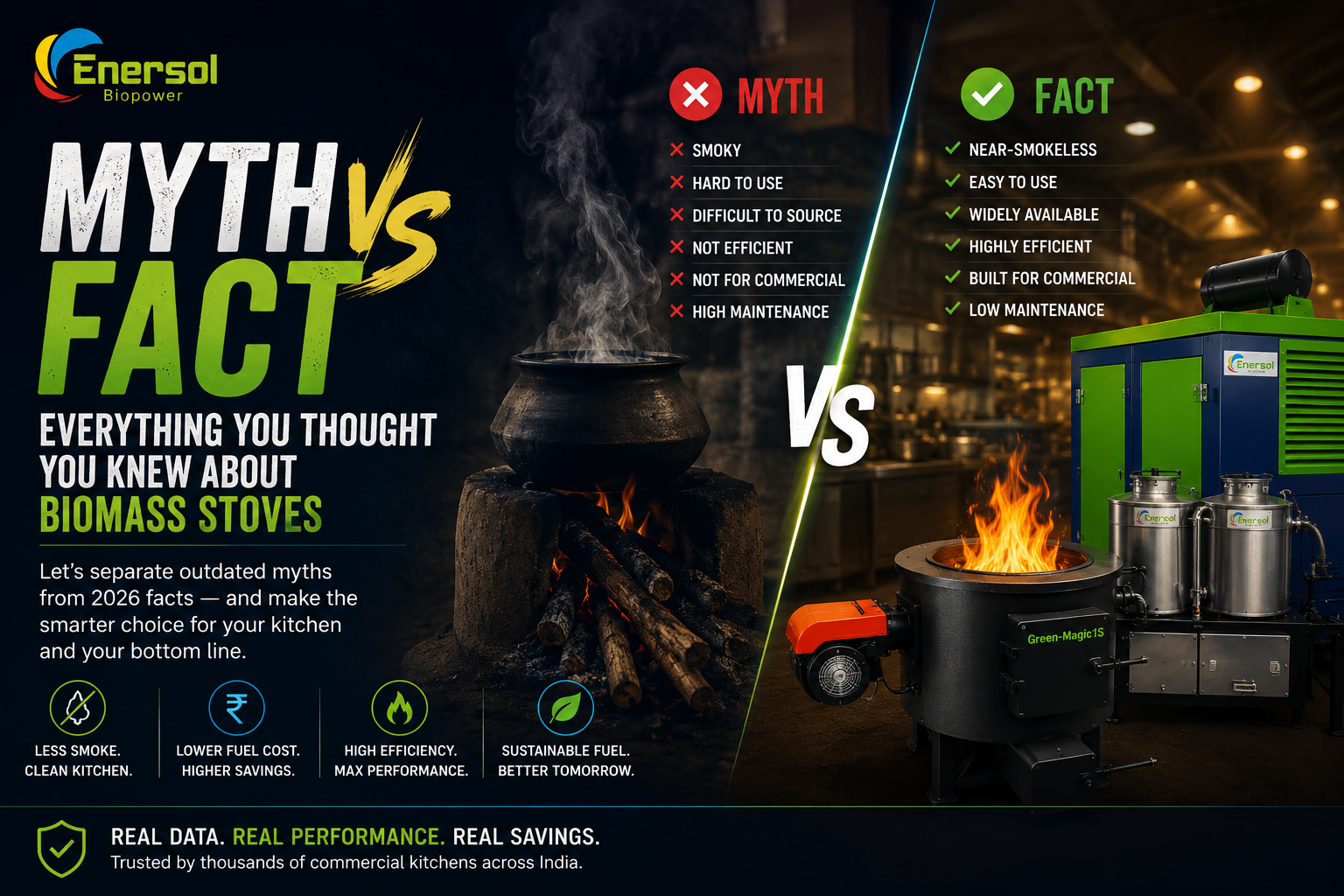
Ask any dhaba owner, halwai, or canteen manager why they haven't switched from LPG to biomass, and you will hear the same five or six objections. Some are rooted in experience with traditional chulhas from 20 years ago. Some come from watching a neighbour's poorly designed stove fill a kitchen with smoke. Some are simply misunderstandings about what modern biomass technology looks like.
The problem is that these myths are costing commercial kitchens real money — ₹40,000 to ₹70,000 per month in avoidable LPG costs. This article takes the 10 most common beliefs about biomass stoves and holds each one against the evidence.
Why These Myths Persist
The image most people carry — a smoky chulha, uncontrollable fire, ash everywhere — is accurate for open-flame traditional designs. That technology still exists. But it is completely inaccurate for modern forced-draft commercial stoves.
Forced-draft technology has existed in commercial biomass stoves since the 1990s. Enersol Biopower has been refining it for 25+ years. The gap between what people believe and what a 2026 commercial unit actually delivers is enormous — and every month that gap stays open, a kitchen pays more than it should.
Biomass Stoves Always Produce Black Smoke
"Every biomass stove I've seen fills the kitchen with black smoke. I can't run a food business like that."
Forced-draft stoves produce near-smokeless combustion with PM2.5 output 60–75% lower than traditional chulhas.
Black smoke comes from incomplete combustion — carbon particles that never fully burned because combustion temperature was too low (500–700°C in traditional stoves). Enersol's forced-draft design raises flame temperature to 900–1,100°C, where nearly all carbon compounds combust completely.
Biomass Fuel Is Hard to Source — I'll Run Out Mid-Cooking
"I can't risk my business on a fuel that might not be available when I need it."
Agricultural biomass briquettes are manufactured within 50 km of most urban and semi-urban commercial kitchen locations and available via weekly bulk delivery.
Unlike LPG — which depends on cylinder availability and dealer allocation — biomass briquettes are locally manufactured from crop residue year-round. A kitchen using 6–8 kg/day needs one 50 kg bag per week. Keep a 3-day buffer stock (15–25 kg) and shortage risk is near zero.
Enersol Biopower can connect you with verified local briquette suppliers in your district.
Biomass Stoves Are Only for Rural or Low-Income Kitchens
"We run a proper commercial kitchen. Biomass is for villages, not for us."
Enersol stoves are installed at IITs, NITs, large hostel canteens, 5-star catering operations, and UNDP-funded international projects.
- IIT Jodhpur and other premier institutions — hostel kitchens cooking 1,000+ meals daily
- Government mid-day meal programs — feeding 500–1,000 children per day
- Export-certified food processing units where FSSAI and international compliance is mandatory
- UNDP technology transfer projects — deployed in Africa and the Middle East
The technology scales from a 1-burner unit for a 50-seat dhaba to multi-burner industrial installations for 2,000+ meals per day.
I'll Lose Flame Control Compared to LPG
"With gas I can adjust the flame instantly. With solid fuel I'll have no control. My dishes will burn."
Variable fan speed control provides equivalent heat adjustment to an LPG burner knob. Response time is 15–30 seconds.
Every Enersol stove comes with a manual fan speed control dial. Cooking tasks requiring fine control — tempering spices, making sweets, reducing gravies — all work without issue.
Food Will Taste Smoky or Different
"My customers will taste the difference. I can't risk my reputation over fuel savings."
A forced-draft stove with complete combustion produces dry, odourless heat. There is zero smoke contact with food.
Smoke flavour in food only occurs when incomplete combustion sends smoke particles into the cooking zone. In a forced-draft stove operating at 35–40% efficiency, combustion completes before exhaust reaches the cooking surface. The heat is dry and clean — identical in character to LPG.
Thousands of commercial kitchens across India cook halwa, gulab jamun, biryani, and dal on Enersol stoves daily. Customer taste feedback is indistinguishable from LPG-cooked food.
Switching Means Closing My Kitchen for Weeks
"I can't afford to shut down. Even a few days of lost business would cancel out the savings."
Installation takes 1–2 days. Most kitchens are fully operational on biomass within one week with zero business interruption.
In multi-burner kitchens, stoves are replaced one by one — zero downtime at any stage.
Biomass Stoves Are Not FSSAI Compliant
"My inspector will fail me if I'm using a biomass stove. I can't risk my food licence."
Biomass briquettes from agricultural waste are a recognised fuel under FSSAI guidelines. Enersol stoves meet all operational compliance requirements.
FSSAI governs food safety — hygiene, contamination, and handling. The three compliance requirements for stoves are:
- Enclosed fuel chamber — no open fuel exposure in the cooking zone ✓
- Routed exhaust — smoke directed away from food preparation areas ✓
- Zero fuel-food contact — fuel never contacts food at any stage ✓
You Need to Constantly Feed the Stove — Too Much Work
"My cook already works hard. I can't have them feeding a fire every 10 minutes on top of everything else."
Commercial briquettes burn 45–90 minutes per load. Enersol stoves accept 4–6 kg per loading. Ash removal is 5–10 minutes once per day.
This is comparable to how often LPG cylinders are changed in a heavy-use kitchen (2–4 cylinders per day × connection/disconnection time). The labour difference is negligible.
Once You Factor in the Stove Cost, LPG Is Actually Cheaper
"The stove costs ₹80,000. By the time I recover that, the savings aren't that great."
For a kitchen spending ₹50,000/month on LPG, payback on an Enersol stove is 30–60 days. Over 5 years, total savings exceed ₹20–30 lakh.
| Factor | LPG | Enersol Biomass |
|---|---|---|
| Monthly fuel cost | ₹54,000–₹90,000 | ₹9,000–₹16,000 |
| Monthly saving | — | ₹38,000–₹74,000 |
| Stove cost | — | ₹45,000–₹1,20,000 |
| Payback period | — | 30–60 days |
| 5-year savings | — | ₹22 lakh – ₹44 lakh |
Biomass Burning Is Bad for the Environment — Like Coal
"Burning biomass releases CO₂ just like fossil fuels. It's not a green option."
Agricultural biomass is carbon-neutral under IPCC guidelines. Coal is fossil carbon. These are fundamentally different processes.
Coal releases carbon sequestered underground for 300–350 million years. Agricultural biomass releases carbon absorbed during that crop's growth — 6 to 12 months ago. Under IPCC accounting, this is the biogenic carbon cycle — net zero carbon impact.
Using agricultural waste as fuel also:
- • Eliminates open-field burning (India's worst air pollution source)
- • Displaces LPG — a fossil fuel
- • Reduces PM2.5 by 95% vs open burning
- • Creates farmer income from crop residue
Open field burning of same residue:
- • 3 kg PM2.5 per tonne burned
- • 14 kg CO per tonne
- • 3 kg SO₂ per tonne
- • Zero useful energy output
Quick Reference: All 10 Myths vs Facts
| Myth | Fact |
|---|---|
| Biomass = black smoke | Forced-draft = near-smokeless; PM2.5 ↓ 60–75% |
| Fuel hard to source | Available within 50 km; weekly bulk delivery |
| Only rural kitchens | Installed at IITs, UNDP projects, 5-star catering |
| No flame control | Variable fan speed = same as LPG knob |
| Food tastes smoky | Complete combustion = no smoke contact with food |
| Weeks of downtime | 1–2 day install; fully operational in 1 week |
| Not FSSAI compliant | Fully compliant; enclosed chamber + routed exhaust |
| Constant feeding | 45–90 min per 4–6 kg load; ash once/day |
| LPG cheaper after cost | 30–60 day payback; ₹22–44 lakh over 5 years |
| Bad for environment | Carbon-neutral (IPCC); replaces fossil fuel + field burning |
Frequently Asked Questions
Is there a biomass stove for a small dhaba with limited space?
Yes. Enersol's compact single-burner units are designed for tight kitchen layouts. Footprint is 60×60 cm for the 150 kg kadhai capacity model — comparable to a standard LPG burner setup.
Can I trial a biomass stove before fully committing?
Contact Enersol Biopower to discuss trial arrangements. Many kitchens run a biomass stove alongside LPG for 2–4 weeks before fully transitioning — comparing costs and output before making a final decision.
What happens to the ash? Is it a disposal problem?
Ash from agricultural biomass is 3–8% of fuel weight. For a kitchen using 8 kg/day, that is 240–640 grams — manageable in a standard bin. Agricultural ash is a useful soil amendment and can often be given to nearby farmers.
How do I know which Enersol stove model is right for my kitchen?
The key factors are your daily cooking hours, maximum vessel size (kadhai capacity), and number of burners needed. Enersol Biopower conducts a free site assessment to recommend the right configuration for your specific load.
Ready to Switch? Let Us Show You.
Book a free site visit. We will assess your kitchen, calculate your exact monthly saving, and demonstrate the stove at your location — before you spend a rupee.
Book Free Demonstration
About the Author
Rai Singh Dahiya
Founder & Chief Innovator, Enersol Biopower Pvt. Ltd.
Grassroots innovator and recipient of India's Fifth National Grassroots Innovation Award (2009). Selected as Innovation Scholar-in-Residence at Rashtrapati Bhavan (2015). Over 25 years of experience pioneering clean biomass energy solutions deployed at IITs, NITs, and in UNDP international projects across Africa and the Middle East.